This guide shows organizers how to connect a custom SMTP provider so Eventify event emails are sent from your own domain instead of [email protected].
By default, all emails sent from Eventify (welcome emails, ticket confirmations, password resets, custom communications, etc.) go out through Eventify's own SMTP servers from [email protected].
If you'd rather have those emails sent from your own domain — so attendees see your company name in the "From" address and replies land in your inbox — you can plug in your own SMTP provider in just a few clicks.
When should you switch to your own SMTP?
You want emails to come from your branded domain (e.g., [email protected]) instead of Eventify's address.
You want full control over deliverability, bounce handling, and reply routing.
Your organization's compliance or IT policy requires outbound email to flow through an approved gateway.
Step-by-step: configure your own SMTP
Step 1. In the Eventify admin panel, go to Email Templates.
Step 2. Click the Settings (gear) icon at the top-right of the Email Templates screen.
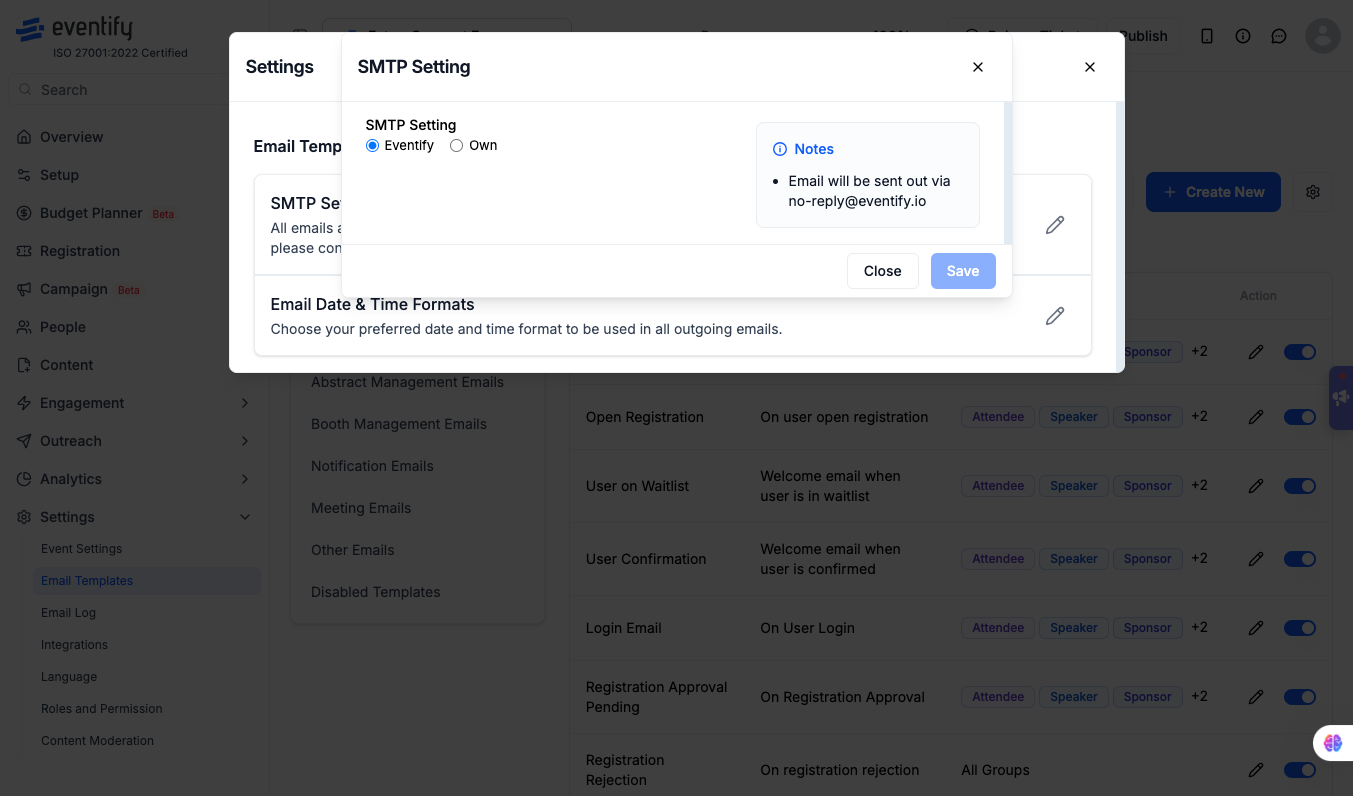
Step 3. A pop-up titled SMTP Settings will open. By default it shows: "All emails are sent using Eventify's default SMTP servers. To use your own SMTP provider, please configure the settings here." Click the pencil (edit) icon to start editing.
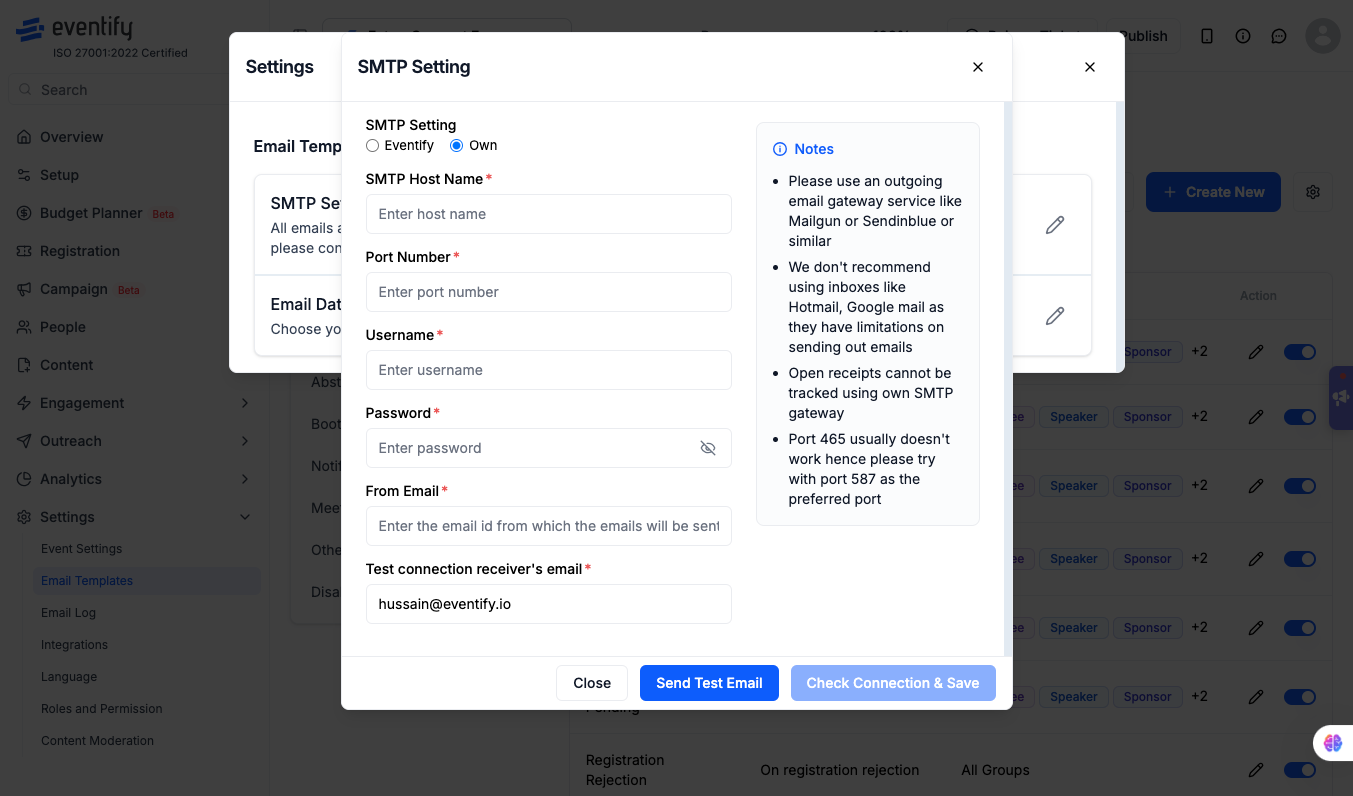
Step 4. Switch the option from Eventify SMTP to Own SMTP, then click SMTP Setting to open the configuration form.
Step 5. Fill in the following details (all fields marked with * are mandatory):
SMTP Host Name* — the server address provided by your email gateway (e.g., smtp.mailgun.org, smtp-relay.sendinblue.com).
Port Number* — the outbound port. We strongly recommend 587 (see notes below).
Username* — the SMTP username issued by your provider. This is usually not the same as your login email.
Password* — the SMTP password / API key issued by your provider.
From Email* — the address attendees will see in the "From" field (e.g., [email protected]). This domain must be verified with your SMTP provider.
Test Connection Receiver's Email* — any inbox you control. Eventify will send a test message here to confirm the credentials work before saving.
Step 6. Click Save. Eventify will run a test send to the address you provided in Test Connection Receiver's Email. If the test passes, your SMTP is live — every outbound event email will now be sent through your own gateway.
Important notes & best practices
Use a dedicated outbound email gateway such as Mailgun, Brevo (formerly Sendinblue), Amazon SES, SendGrid, Postmark, or similar. These services are purpose-built for high-volume transactional email and handle authentication (SPF, DKIM, DMARC), reputation, and bounces correctly.
Avoid personal mailbox providers like Gmail, Google Workspace, Hotmail, Outlook.com, or Yahoo Mail. They impose strict daily sending limits, throttle bulk sends, and will silently drop or block event-scale mailings — your attendees simply won't receive emails.
Use port 587, not 465. Port 465 frequently fails on our infrastructure. Always try 587 first as the preferred port — it works reliably across virtually every modern SMTP provider.
Open tracking is not available on Own SMTP. When you switch to your own gateway, Eventify can no longer track email open rates because open tracking pixels are injected by our default SMTP layer. If open analytics matter to you, stay on Eventify's default SMTP, or rely on your provider's native analytics dashboard (Mailgun, SendGrid, etc. all offer their own).
Verify your sending domain with your SMTP provider before going live. Without proper SPF/DKIM records pointing to your provider, your emails will land in spam folders.
Want to keep using Eventify's default SMTP?
No action needed. If you don't configure your own SMTP, all outbound emails will continue to be sent from [email protected] — and you'll keep full open-tracking analytics.
Troubleshooting
Test connection fails: double-check the host, username, and password. Most failures are caused by a typo, a wrong port (try 587), or an unverified sender domain on the provider side.
Emails go to spam: add SPF and DKIM records for your sending domain in your DNS, following your SMTP provider's setup guide.
Some emails arrive, others don't: check your provider's dashboard for bounce, suppression, or rate-limit logs.
If you run into trouble, reach out to Eventify support and we'll help you validate the configuration end-to-end.
Frequently Asked Questions
Which SMTP port should I use?
Use port 587. Port 465 frequently fails on Eventify's infrastructure, while 587 works reliably with most SMTP providers.
Can I use Gmail or Outlook as my SMTP provider?
It is not recommended. Personal mailbox providers such as Gmail, Google Workspace, Outlook.com and Yahoo Mail have daily sending limits and can drop event-scale mailings, so use a dedicated gateway like Mailgun, Brevo, Amazon SES, SendGrid or Postmark.
Will I still see email open rates with my own SMTP?
No. Open tracking only works on Eventify's default SMTP. With your own gateway, use your provider's analytics dashboard instead.

.png)