.png)


Key Takeaways
- The right virtual event platform helps you manage registration, attendee engagement, and post-event analytics so you can generate better leads, not just run a video call.
- Eventify, ON24, and Goldcast top this list for their complete virtual event solutions, best suited for enterprise webinars.
- If you're focused on expo booths and exhibits, vFairs, Eventify, and Airmeet are the strongest options.
- If you need a simple 1-hour session or meeting with no setup hassle, Google Meet and Microsoft Teams are the most affordable options.
- If lead generation is the priority, ON24 and Goldcast deliver the strongest results on a reliable budget.
Introduction
Virtual and hybrid events are often considered harder to organize than in-person events because attendee engagement drops off so quickly. You know it's a disaster when you start losing attendees in the first hour of the webinar. Understanding the resources these types of virtual events actually require is exactly why virtual event hosting platforms exist.
A good platform handles event registration, event ticketing, attendee engagement, and networking while you deliver the webinar that generates leads. Some virtual event platforms bolt on features like interactive expo booths and virtual worlds for attendees to explore, turning a simple broadcast into something closer to a full virtual event.
In this list, we'll cover the top 10 virtual events platforms, evaluated on functionality, transparency, price, and reviews from third-party sites like G2 and Capterra, so you can host virtual events with confidence.
My Top Picks: A Quick Review
If you don't have time to read the full comparison table and in-depth reviews below, here's the short version.
Best Overall: Eventify
Eventify tops this list because it's the only platform here built to run virtual, hybrid, and in-person events from a single dashboard, priced with a flat monthly rate instead of an attendee tax. If you host more than one type of event a year, it's the safest default pick and the best value virtual event platform on this list.
Best for Enterprise Webinar Analytics: ON24
ON24 is built for marketing and sales teams that live and die by pipeline data. Its attendee behavior tracking and CRM integrations turn every webinar into measurable lead generation, which makes the learning curve and enterprise pricing worth it at that scale.
Best for Expos and Trade Shows: vFairs
vFairs' 3D virtual lobbies and booth spaces do more for exhibitor ROI than any general-purpose webinar tool, making it the strongest online event platform if your event is built around exhibitors and networking rather than a single stage.
The 10 Best Virtual Event Platforms Compared: A General Overview
| Platform | Best For | Pricing | Free Plan | Entry-Tier Attendee Limit |
|---|---|---|---|---|
| Eventify | Multi-format: in-person, virtual, and hybrid | Starts at *** | Yes | Not based on attendee volume |
| ON24 | Enterprise webinar marketing & analytics | Quote-based | No | Varies |
| Goldcast | B2B demand generation, pipeline-focused events | Quote-based | No | Varies |
| Expo Pass | Interactive conferences with networking | Quote-based | No | Varies |
| Airmeet | Interactive conferences with networking | Starts at $199/month for 100 attendees | Yes (limited) | 100 attendees per tier |
| vFairs | Large-scale career fairs, trade shows, expos | Quote-based | No | 1,000 (scalable) |
| Google Meet | Teams already on Google Workspace | Starts at $7/user/month for 100 attendees | Yes | 100 attendees per tier |
| Microsoft Teams | Orgs already on Microsoft 365 | Starts at $6/user/month for 100 attendees (Microsoft 365 users only) | Yes | 300 attendees per tier |
| Zoom Events | Multi-track virtual/hybrid conferences on Zoom | Starts at $149/month for 100 attendees, extended features billed separately | Yes | 100 to 500 attendees per tier |
| GoTo Webinar | Straightforward corporate webinars | Starts at $69/month for 500 attendees | No | 100 attendees per tier |
Methodology: How We Evaluated These Platforms
Every virtual event platform on this list was evaluated using the highest-tier free demo or trial available, the same way you'd test any online event platform before committing budget to it. Other functionality details and prices are supplemented by documentation provided directly by each vendor. We also referenced third-party review data from sites like G2 and Capterra, current as of August 2026.
Several virtual event vendors, including vFairs, ON24, and Goldcast, don't publish their prices; they're revealed on a quote basis tied to your specific requirements. Any price estimate for those platforms is therefore based on vendor documentation or third-party sources rather than a published rate card, and pricing is solely the vendor's to change. It's worth confirming current rates directly before you commit. Notes on usability or "learning curve" reflect our own hands-on experience with each platform unless a source is cited.
Is this actually built for events, or a meeting tool with event features tacked on?
This was the gut-check question right out of the gate. Some big names on this list, like Google Meet and Microsoft Teams, are clearly video-conferencing tools at heart, with webinar or town-hall modes layered on top at the higher tiers. Others, like Eventify and vFairs, were designed around the full event lifecycle from the start. Neither approach is automatically right or wrong, but knowing where a platform started changes what you should expect it to do well without a lot of extra effort on your end.
Does it handle registration, ticketing, and branding without workarounds?
A platform isn't truly usable unless you can build a customizable registration page, segment attendees into different ticket types or categories, and brand the whole experience so it doesn't look like a generic meeting invite. We checked whether these features were native to the platform, or whether you'd have to duct-tape a third-party form tool on top just to get people in the door.
Is this platform actually safe for attendee and organizer data?
This was a non-negotiable question. We checked whether each platform takes data protection seriously in its actual infrastructure, not just its marketing copy, specifically looking for recognized industry standards like ISO 27001:2022 and SOC 2 Type 2 certification. These indicate robust security controls, regular third-party audits, and clear data-handling protocols. We also verified GDPR coverage, since attendee data often spans multiple regions and carries strict privacy requirements with real fines for violations. The platforms with these certifications and clear GDPR policies moved straight to the top of the list.
How transparent and predictable is the pricing, really?
This is where it got frustrating. Several platforms in this space, including ON24, Goldcast, and vFairs, don't publish a single number anywhere. You only get a quote after sitting through a sales call, and that number tends to shift based on attendee volume, how often you run events, and whatever add-ons you ask for. Platforms with published, flat, or tiered pricing made the budgeting process exponentially easier, especially when planning for a full year of events rather than a one-off.
What does the platform do for lead generation and post-event data?
Most organizations aren't running virtual events for logistics alone; it's a marketing and sales play. We dug into how well each platform integrates with major CRM and marketing automation tools like Salesforce, HubSpot, and Marketo, and what kind of usable engagement data you actually walk away with, not just a pile of raw numbers you have to make sense of yourself.
What do independent reviewers actually say?
Glossy marketing pages only tell you so much, so we spent time on G2, Capterra, and GetApp to see what real users were praising and complaining about. Those reviews were the best tool for poking holes in vendor claims, especially around support quality, how complicated the interface really is, and whether people felt like they got their money's worth. Those three areas are where marketing promises and daily user experience tend to diverge the most.
The 10 Best Virtual Event Platforms Reviewed In Depth
1. Eventify
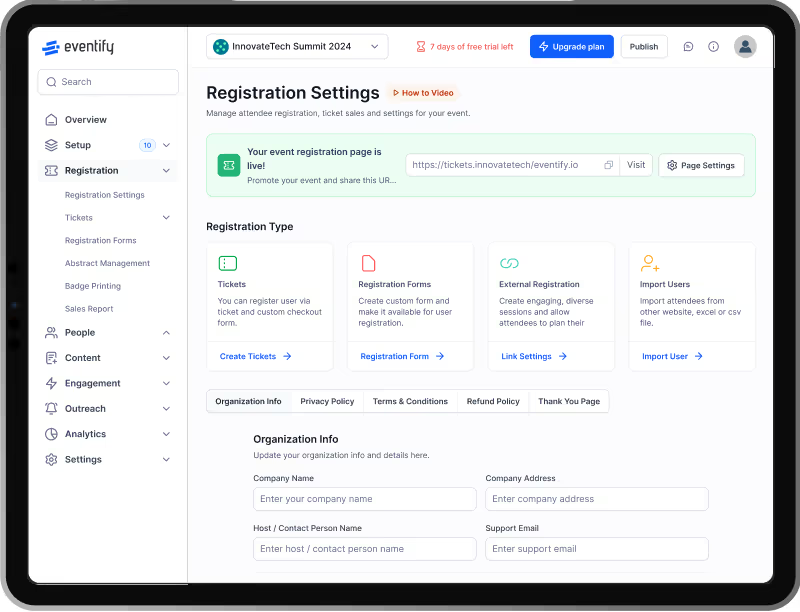
Eventify is a complete event solution whether you're running a virtual, hybrid, or in-person event. You manage every event type through a single dashboard, so you're not shuffling between different calendars and tools for each format.
For virtual events specifically, Eventify offers live streaming, Q&A, live polls, live chat, and 1:1 virtual networking space. A standout is AI-powered business matchmaking, which pairs attendees with each other based on interest or region.
Sponsors and exhibitors can set up virtual booths with content like photos, videos, and upcoming products, similar to the interactive setups covered in our guide on selling out expo booths. Attendees stay engaged through gamification features that keep the event feeling lively, while Eventify automatically tracks attendee data, engagement, and event details in one consistent database.
Eventify has its own streaming infrastructure, but its virtual event app also integrates with leading platforms including Zoom, YouTube Live, Vimeo, and WebinarJam, a real advantage for organizers who don't want to force attendees onto a new app. On pricing, Eventify charges a flat monthly rate rather than a per-attendee or per-ticket fee, so you can run a virtual event with 100 or 1,000 attendees while paying for the same set of features.
Another standout is the security posture. Eventify offers ISO 27001:2022 and SOC 2 Type 2 certification, plus GDPR coverage for both hosts and attendees.
Pricing: Plans start from ***; contact the team for pricing on specific features. A free plan is also available for smaller events.
Pros:
- Centralized database across virtual, hybrid, and in-person events
- Easy-to-navigate dashboard for every setup
- Multiple gamification and booth setup options
- AI-powered matchmaking and networking for virtual attendees
- Security coverage under ISO 27001:2022 and SOC 2 Type 2 certification
- Flat price for the event, independent of attendee volume
- CRM and payment integrations with platforms like Zoom, YouTube, and Stripe
Cons:
- Not specialized for pure-play webinars
2. ON24
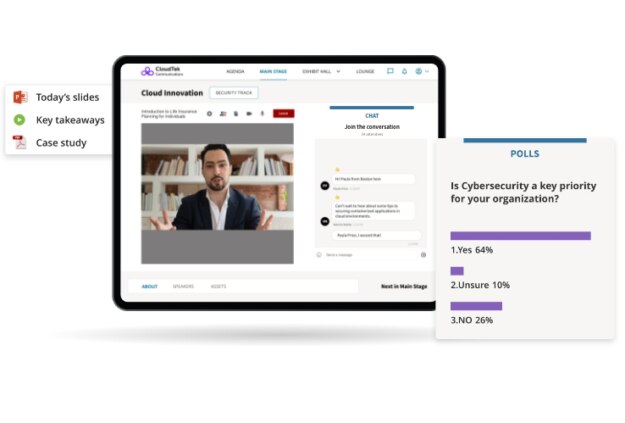
ON24, now part of Cvent, is an online conference platform built specifically for enterprise webinars. It supports live, simulive, and on-demand formats, and its engagement hubs help hosts build content and experiences during the webinar and after it ends.
The standout feature is attendee behavior tracking, which feeds data gathered from attendees straight into CRM systems like Salesforce or HubSpot to generate leads. ON24 also has an ACE AI engine that automatically repurposes webinar content into written and video formats.
ON24 has many engagement features, including live Q&As, polls, and chat, backed by security certifications like SOC 2 Type II, ISO 27001:2022, ISO 27701:2019, and APEC PRP for data protection. Pricing is quote-based, so it helps to know exactly what you want before contacting the team.
Pricing: Not publicly available. ON24 offers a three-tier plan structure (Essential, Standard, Advanced) based on the features required, quoted upon contact. There's no free plan.
Pros:
- More than 20 tools available for attendee engagement
- ACE AI engine for repurposing webinar video and recordings
- CRM integrations for better lead generation
- Built-in attendee behavior analysis and reporting
- Security certifications including SOC 2 Type II, ISO 27001:2022, ISO 27701:2019, and APEC PRP
Cons:
- Users often face CRM configuration delays
- The dashboard isn't especially intuitive and has a steep learning curve
- Can be expensive for occasional webinars
3. Goldcast

Goldcast, also owned by Cvent, is a B2B-focused virtual event platform designed around pipeline generation, with broadcasting built in as part of the process. It's a strong fit for organizers who want to interact with attendees directly to drive revenue impact from events.
The dashboard is intuitive and helps organizers interact with attendees through customizable rooms and networking lounges. It also offers AI tools for turning event highlights into content for social media and marketing.
Goldcast holds SOC 2 Type 2 certification and follows the EU-U.S. Data Privacy Framework Principles to protect data for online events. Pricing is quote-based, similar to ON24, and based on user reviews from G2 and other third-party sites, cost tends to climb with attendee count. If you're evaluating it primarily for marketing impact rather than budget, it's a strong choice.
Pricing: Not publicly available. Goldcast lists three tiers, Content Lab, Recording Studio, and Digital Events, each quoted based on the features you need.
Pros:
- Easy-to-use dashboard
- Built-in AI-assisted marketing tools
- Easy CRM integration
- Strong customer service
Cons:
- Reviews mention limited networking room capacity on lower tiers
- Reported as "expensive" relative to other platforms
4. Expo Pass
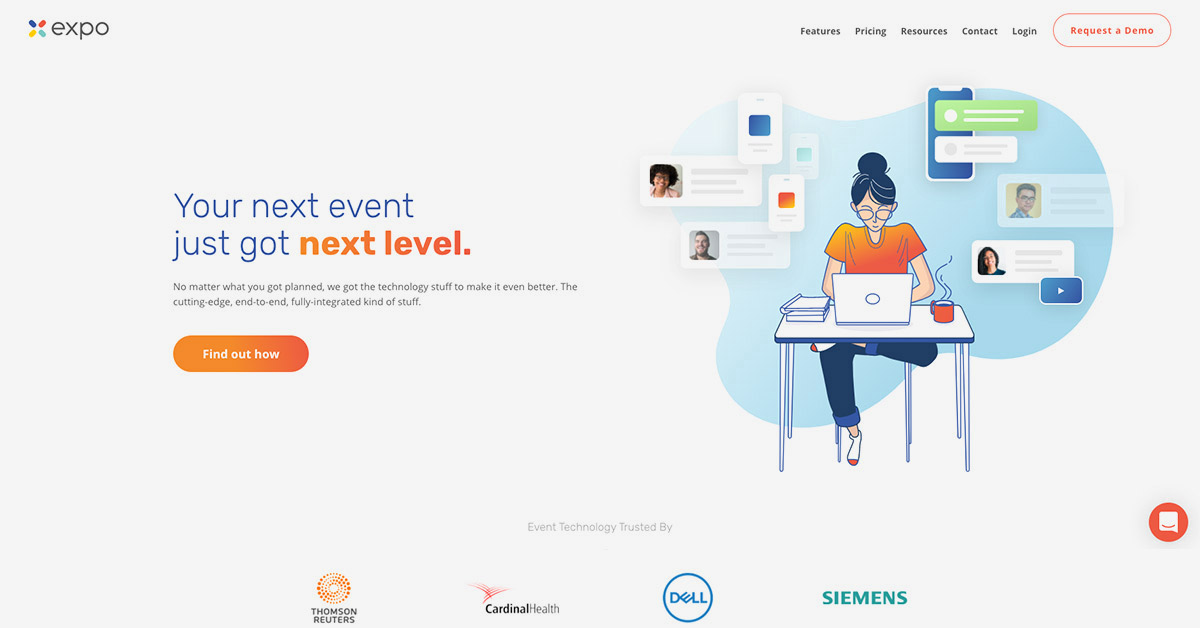
Expo Pass is a digital event platform built for virtual and hybrid events, with audience engagement as its main focus. It offers an easy-to-use virtual event app for both organizers and attendees, handling schedules, updates, and networking opportunities. Attendee engagement also includes real-time Q&A, interactive polling, and digital sponsor or exhibitor spaces.
Its lead retrieval tool helps track attendee data into new leads, and CRM integration options include Swoogo and Avery. Expo Pass doesn't carry an advanced security certification for live data beyond PCI DSS Level 1 compliance for secure registration payment processing via Stripe.
Pricing is quote-based, but one G2 review sums up the value trade-off well: "ExpoPass is a bit pricey, but it is worth every penny," with the same review noting the "ExpoPass team members help you with everything," a good sign for customer service.
Pricing: Not available publicly.
Pros:
- Easy-to-use event mobile app for attendees and organizers
- CRM integration options available
- Enhanced interactive app sections for attendees
- Attendee tracking for analytics and lead generation
- Good customer service
Cons:
- On the pricier side
- No advanced security certification for data protection
5. Airmeet
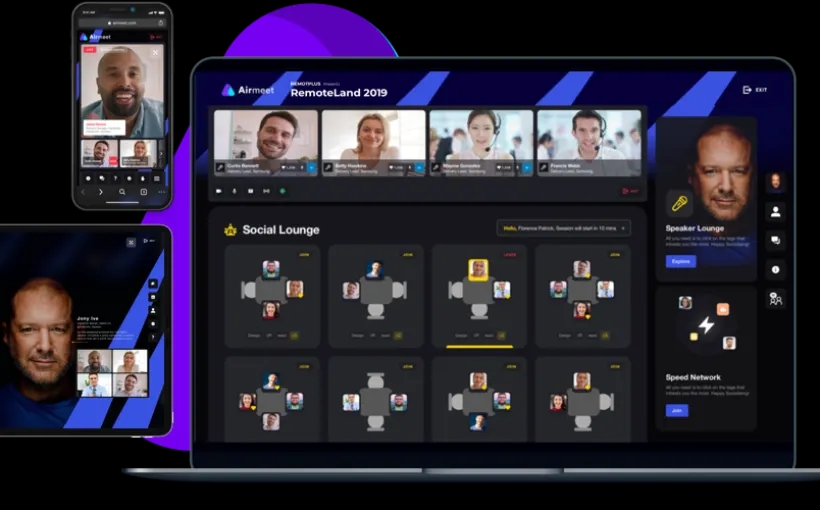
Airmeet is a virtual networking platform built to make virtual events feel less passive. It includes features like virtual tables, breakout rooms, and networking lounges designed to mimic being at an in-person event. The engagement and networking tools stand out, and multiple users describe these features as a real differentiator compared to other platforms.
A highlight is the AI assistant called "AirGenie," which handles event content generation, taking real work off your plate.
Airmeet holds ISO 27001:2022 information security certification and is SOC 2 Type 2 attested. CRM integrations are available with Zoom, Salesforce, HubSpot, Mailchimp, Eventbrite, Stripe, PayPal, Google Calendar, Zapier, and more.
The dashboard is a bit complex and takes time to get familiar with, but beyond that, the AI tools help surface event insights both during and after the event.
Pricing: Airmeet has three tiers, starting at $199 per month for two organizers and 100 attendees, scalable to 1,000 attendees; the higher two tiers are quote-based. A free sign-up option is also available without a credit card.
Pros:
- Strong networking options
- AI-assisted event content generation and analytics
- CRM integration options available
- ISO 27001:2022 and SOC 2 Type 2 information security certification
Cons:
- Dashboard has a learning curve
6. vFairs
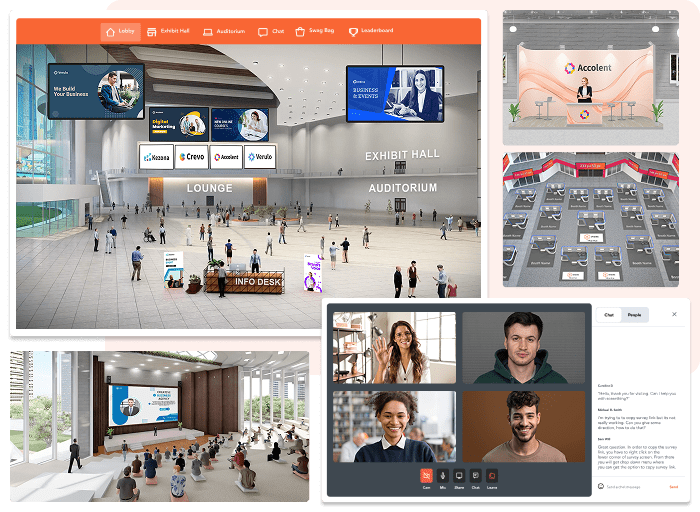
vFairs is a strong option for sponsors and exhibitors thanks to its 3D virtual lobby and booth space, which is highly interactive for attendees and is what makes the platform stand out. It also offers structured networking through one-to-one meetings via its mobile app, well suited for a hybrid trade show format.
CRM integration is described as effortless by reviewers on Capterra and G2. It captures engagement data but expects your CRM and marketing automation tools to handle their own lead management from there.
vFairs holds major enterprise-grade security certifications and compliance standards, including SOC 2 Type II, ISO 27001, PCI DSS, and Microsoft SSPA. Like other platforms on this list, vFairs pricing is quote-based; see our full vFairs pricing breakdown for what to expect before you talk to sales.
Pricing: Not publicly available.
Pros:
- Interactive 3D virtual lobbies for exhibit booths, career fairs, and expos
- Extensive expo and booth customization
- Easy-to-navigate mobile app
- Enterprise-grade security certifications
Cons:
- Positioned as an execution tool rather than a marketing or CRM tool
7. Google Meet
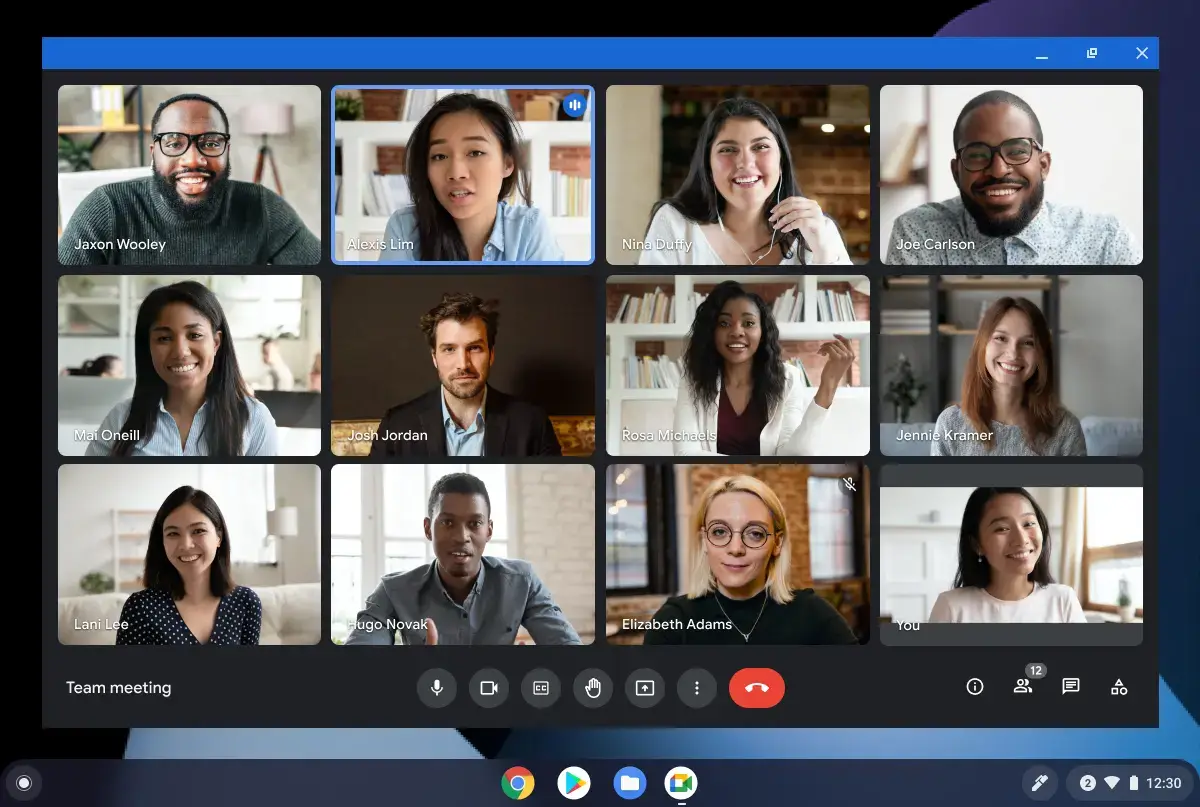
Google Meet isn't an event-dedicated platform; it's a video conferencing tool inside Google Workspace. There's no automated registration page setup, ticketing, or booth setup, but you can sync it with Google Calendar or Drive for a low-friction meeting experience.
The platform is easy to use and works well for a basic webinar or lecture with limited attendee interaction. What stands out is live translation and captions, paired with strong video and audio quality.
Google Meet, via Google Workspace, holds major global security and compliance certifications, including SOC 2 / SOC 3, ISO 27001, ISO 27017, ISO 27018, FedRAMP Moderate, and support for HIPAA compliance through a Business Associate Agreement (BAA).
On plan tiers: the free tier gives 60 minutes of group calling with 100 attendees. Paid tiers split into four categories: Business Starter with 24-hour calls and 100 attendees, Business Standard with 24-hour calls, 150 attendees, and breakout room access, and Business Plus with 24-hour calls, 500 attendees, and breakout room access. The Enterprise tier supports 1,000 attendees as a broadcasting tool. All plans include cloud storage.
Pricing: The basic plan is free for 60 minutes with 100 attendees. Business Starter runs about $7 per user per month, Business Standard about $14 per user per month, and Business Plus about $22 per user per month. Enterprise is custom-priced.
Pros:
- Runs in the browser or on mobile through the Google Workspace suite app
- Straightforward and easy to use
- Very affordable
- Strong video and audio quality
- Live caption and translation options available
Cons:
- Integrations limited to Google Workspace suite apps like Calendar and Drive
- Little to no attendee engagement tools
- No registration setup, ticketing, analytics, or marketing tools
8. Microsoft Teams
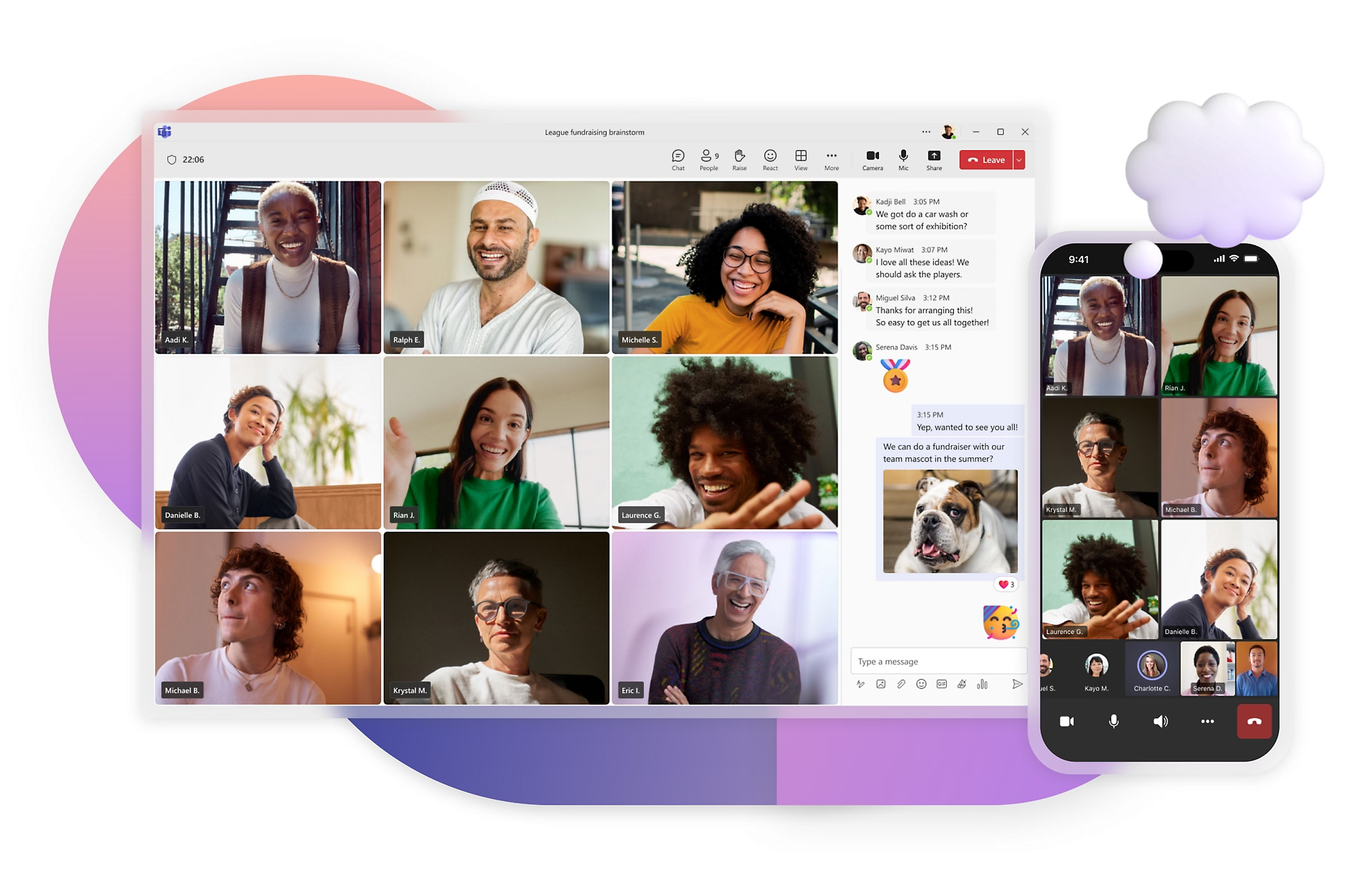
Microsoft Teams is sold as part of the Microsoft 365 suite, not separately. The platform offers webinar and town hall features, with Copilot AI integrated for easy meeting recap generation. What sets it apart is the registration waitlist feature, along with presenter bios and custom branding for the meeting. Overall, it's a straightforward, professional-feeling space, ideal for one-to-one corporate meetings, webinars, and educational lectures.
On data security, Microsoft brings its own enterprise credentials, including managing security settings, compliance policies, and information barriers within Teams.
Microsoft Teams has a basic free plan for 60 minutes with 100 attendees, like Google Meet. Beyond that, plans are based on Individual, Business, and Enterprise tiers, further split into 3 to 4 price tiers with add-on perks like rooms supporting up to 10,000 attendees.
Pricing: The basic plan is free for 60 minutes with 100 attendees. Paid plans are based on Individual, Business, and Enterprise tiers, priced by attendee count, add-ons, and cloud storage.
Pros:
- Strong security setup backed by Microsoft
- Scalable to 10,000 attendees with breakout room perks
- AI-powered meeting recaps and captions
- Built-in registration and custom branding features
Cons:
- Costs add up quickly with add-ons
- Not a stand-alone product; best for existing Microsoft 365 users
9. Zoom Events
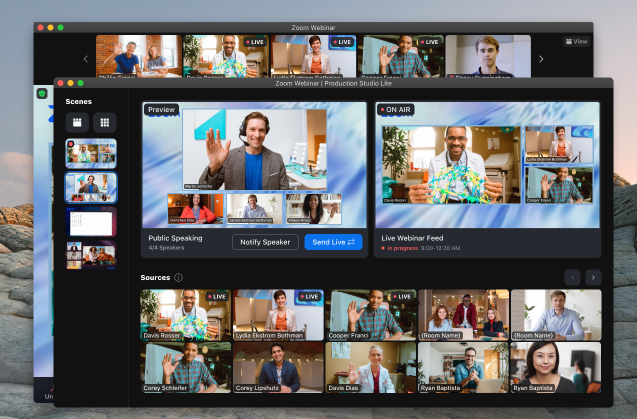
Zoom Events is essentially Zoom's video streaming infrastructure upgraded into a full conference platform with an event management layer. It comes with customizable registration, ticketing, chat-enabled networking lobbies, and expo or exhibit booths.
You can build a multi-day or multi-track event on the platform rather than a single long broadcast, well suited for a full virtual conference format. It also comes with a mobile app for organizers and attendees so everything is accessible in one place, and it holds global data security certifications like ISO 27001 and SOC 2 Type II.
Pricing runs in tiers: a basic free plan supports 100 attendees. For the Event plan, you can pay based on attendee volume or a monthly-to-annual subscription, with add-ons billed separately.
Pricing: The basic plan is free for 100 attendees. The main Event plan pricing varies by attendee volume and feature add-ons; for reference, the event plan for 100 attendees runs $149 per month, with add-ons billed separately.
Pros:
- Widely familiar, but purpose-built for virtual event management
- Customizable registration and ticketing setup
- Virtual booth and expo floor customization for maximum interaction
- Scalable to large multi-track events
- Strong video and audio quality
Cons:
- Less specialized networking, with limited options
- A basic Zoom subscription is still needed to access Events
10. GoTo Webinar
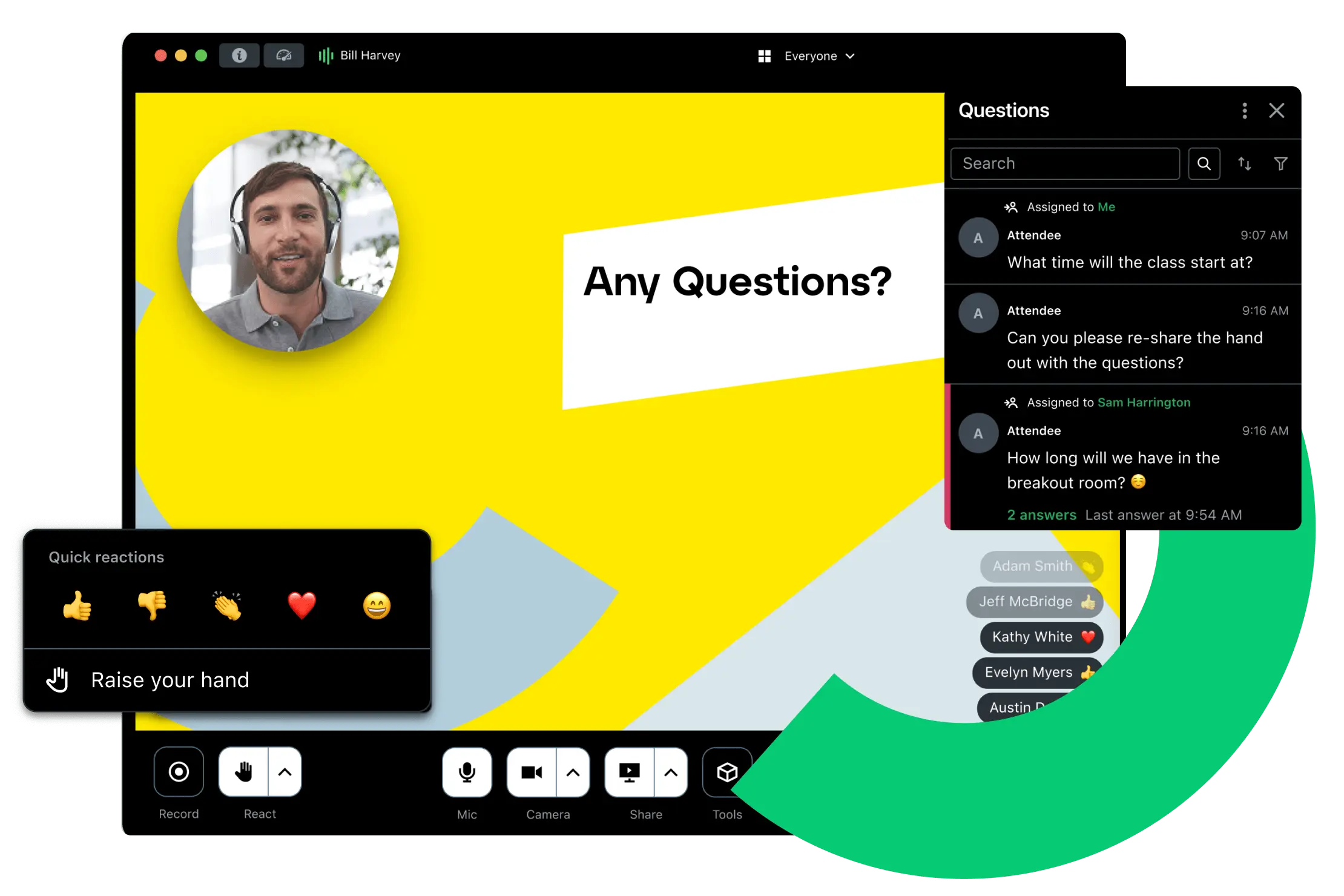
GoTo Webinar is a live event platform built for pre-recorded webinars used in corporate training, educational lectures, customer webinars, and lead-generation sessions, and it shows how webinars actually work at scale. Its long track record, paired with live Q&As, polls, and live analytics, makes it a solid option for recurring webinars. It also includes CRM integration that users describe as "smooth."
The platform maintains compliance frameworks including SOC 2 Type II and ISO 27001 for data security.
GoTo Webinar has no automated marketing or AI content tool options, which makes it more of a basic tool for less complex, pre-defined webinars. Plans start at $69 for 500 attendees per month, a reasonable entry point.
Pricing: Pricing splits into three tiers. The basic "Reach" plan starts at $69 per month for 500 attendees, and "Elevate" starts at $129 per month for 1,000 attendees. The Complete plan is quote-based and accommodates up to 3,000 attendees.
Pros:
- Reliable long track record for webinars
- Strong CRM integration options and setup
- Built-in registration, ticketing, and analytics for lead generation
Cons:
- No automated marketing or AI content tools
- Limited brand customization
Choosing the Best Virtual Event Platform for the Job You Actually Have
Don't overthink this: match the platform to the job in front of you, not the one with the flashiest demo. Running internal town halls or quick team check-ins? Google Meet or Microsoft Teams handles it cheaply since you're probably already paying for the license. Chasing pipeline out of every session? ON24 or Goldcast are built specifically for that kind of lead capture and CRM handoff. Running a career fair, trade show, or large-scale expo? vFairs' 3D booths do more for exhibitor ROI than any general-purpose webinar tool ever will. Need heavy networking without enterprise pricing? Airmeet gets attendees actually talking to each other instead of just watching a stream. Hosting virtual events several times a year across different formats? Eventify's flat monthly fee keeps costs predictable, unlike per-attendee pricing that punishes you the moment an event does well.
The best video and audio quality means nothing if registration feels clunky, the data you walk away with is unusable, or you're stitching together five separate tools just to pull off one event. Stop shopping for flashy features in an event engagement platform, and start shopping for the workflow you and your team will actually stick with past the first event. That's what decides whether a virtual event platform earns its keep for the next one.
Always confirm overage terms before you sign
Quote-based platforms like ON24, Goldcast, and vFairs price around an expected attendee count, and going over it mid-event can trigger a surprise invoice. Ask what happens if registrations spike past your tier before you commit, not after your event sells out.
Frequently Asked Questions
What is virtual event software?
Virtual event software manages the online delivery of an event: registration, live or on-demand video, attendee engagement tools like chat and polls, networking features, and post-event analytics, all in one connected system rather than a bare video call.
What is the difference between virtual event software and a video conferencing tool?
A video conferencing tool like Google Meet or Zoom's base product handles the call itself. Dedicated virtual event software adds registration pages, ticketing, branded landing pages, structured networking, and reporting built specifically for public-facing or large-scale events.
What is the best free virtual event software?
Google Meet's free tier is the most functional free option if you just need a video call for up to 100 people. Zoom Events' free Basic plan is a better fit if you specifically need registration and a networking lobby for a small event.
Which virtual event platform has the lowest cost for frequent events?
Among the platforms reviewed here, Eventify's flat monthly fee is the most predictable option for organizations running multiple events a year, since it doesn't scale with attendee count the way GoTo Webinar, Zoom Events, or Airmeet do.
What is the best virtual event software for lead generation and marketing?
ON24 is the strongest choice for enterprise webinar marketing given its analytics depth and CRM integrations. Goldcast is also worth considering for B2B teams that want similar pipeline attribution with a different feature emphasis.
What is the best virtual event software for large-scale expos or career fairs?
vFairs is purpose-built for this use case, with immersive 3D venues and support for thousands of concurrent attendees.
Does virtual event software include networking features?
Airmeet, vFairs, Eventify, and Goldcast all include structured networking, such as tables, lounges, or scheduled meetings. Google Meet, Microsoft Teams, and GoTo Webinar are more limited here since they weren't built around attendee-to-attendee interaction.
How much does virtual event software cost?
Costs range from free (Google Meet, Microsoft Teams at the entry tier, Zoom Events Basic) to enterprise pricing available only on request (ON24, Goldcast, vFairs). Mid-market platforms typically charge either a per-attendee or per-license fee that scales with event size, or a flat monthly rate with no per-attendee charge.
What integrations should I look for in virtual event software?
Look for native integrations with your CRM (Salesforce, HubSpot) and marketing automation platform (Marketo, Eloqua, Pardot), plus payment processing if you're selling tickets. Confirm what happens to attendee and engagement data after the event closes before committing to a platform.
Can I use Google Meet or Microsoft Teams for a public virtual event?
You can, but both were designed as internal meeting tools first. You'll likely need a third-party registration and landing-page tool alongside either platform if you're running something public-facing, rather than an internal town hall or training session.
.png)