Nederlands
 Deutsch
 Français
 Español
 Italiano
 Svenska
 Português (Brasil)
 Português (Portugal)
 العربية
 Türkçe
 Polski


I'll convince you with arithmetic. The headline number in this post comes straight from our Stripe Connect dashboard, refreshed this morning. Every other figure is calculated from it, or from an assumption that I state.
Ticketing platform fees are easy to underestimate because a percentage looks small. Three percent sounds like a rounding error until it is applied to a year of ticket sales. This post runs real volume through the two common fee models, a percentage of every ticket and a flat amount per ticket, and shows where the money goes.
Live data: $35.4M processed through Eventify
On November 28, 2026, Stripe shows $35,432,913.46 in gross payment volume processed through Eventify since January 1, 2023. The chart below is the Connect overview for our platform, updated at 11:30 AM today.
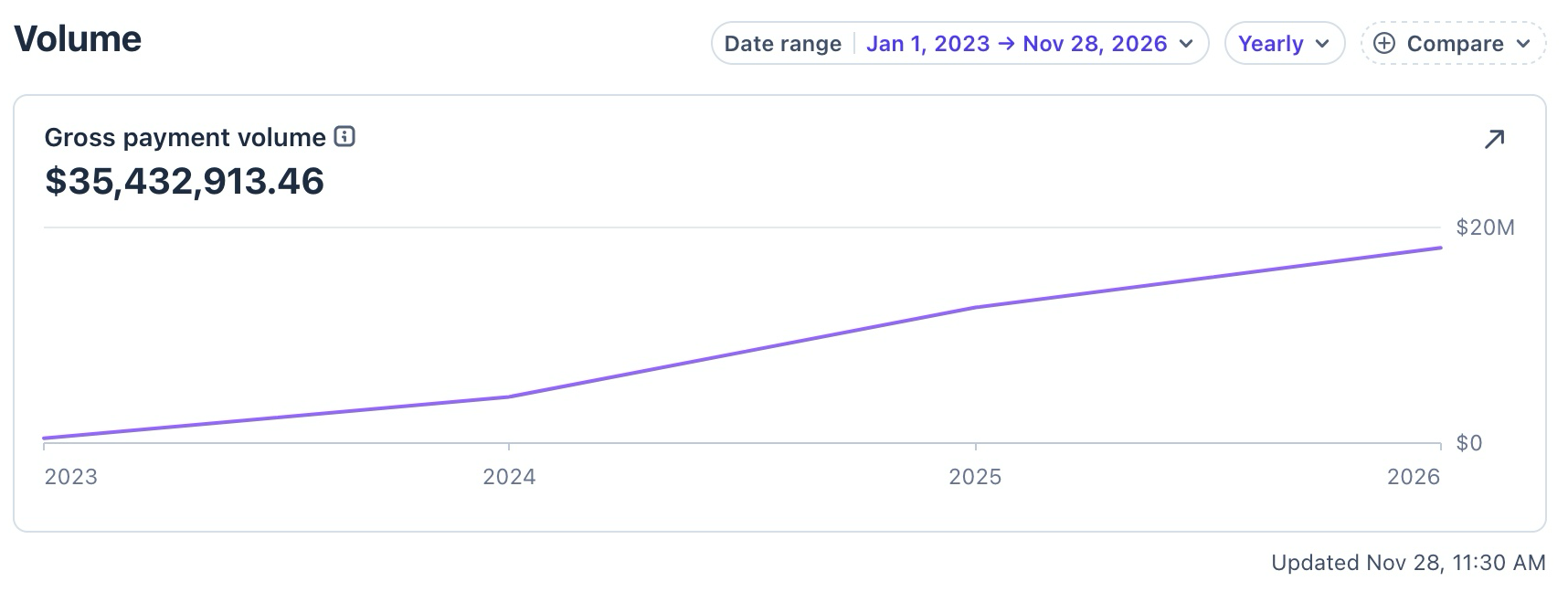
The line rises every year. That is payment volume collected by organizers through Eventify, and it is the base for the calculations below.
How percentage and flat ticketing fees work
A percentage fee takes a fixed share of every ticket sale. At 4%, a $100 ticket costs the organizer $4 and a $1,000 ticket costs $40. The platform earns more every time the price goes up.
A flat fee takes the same amount from every ticket, whatever the price. Eventify charges $1 per ticket. A $100 ticket costs $1 and a $1,000 ticket costs $1.
Payment gateway fees are separate. The card processor charges them on every platform, they are the same wherever you sell, and so they are left out of every comparison in this post. On Eventify you either cover the fees yourself or add them to the buyer's price, and you choose that when you create the ticket.
What 3% to 5% ticketing platform fees would have cost
Percentage-based platforms typically charge between 3% and 5% of each ticket sale. Applied to $35,432,913 of payment volume, that range comes to:
| Percentage fee | Fees on $35,432,913 |
|---|---|
| 3% | $1,062,987 |
| 4% | $1,417,317 |
| 5% | $1,771,646 |
At 3%, the fees come to $1.06 million. At 5%, they come to $1.77 million.
Eventify's $1 per ticket on the same volume
Eventify's event ticketing software charges $1 per ticket, so the total depends on how many tickets that volume represents. The Stripe dashboard shows money, not ticket counts, so I have worked out the ticket count at three average ticket prices. Volume divided by average price gives the number of tickets, and each ticket costs $1.
| Average ticket | Tickets implied | Eventify at $1 per ticket | Saved vs 3% | Saved vs 5% |
|---|---|---|---|---|
| $50 | 708,658 | $708,658 | $354,329 | $1,062,987 |
| $100 | 354,329 | $354,329 | $708,658 | $1,417,317 |
| $250 | 141,732 | $141,732 | $921,256 | $1,629,914 |
Even at a $50 average ticket, the flat fee saves more than $350,000 against 3%. At $100, it saves $708,658 against 3% and $1,417,317 against 5%. At $250, it saves more than $920,000 against 3%. The higher the average ticket, the wider the gap, because the flat fee stays at $1 while the percentage fee keeps growing.
Ticketing fees on one event: flat $1 vs percentage
Most organizers think in events, not in cumulative volume. Here are three event sizes at a $150 average ticket:
| Attendees | Ticket sales | 3% fee | 4% fee | 5% fee | Eventify at $1 per ticket |
|---|---|---|---|---|---|
| 500 | $75,000 | $2,250 | $3,000 | $3,750 | $500 |
| 2,000 | $300,000 | $9,000 | $12,000 | $15,000 | $2,000 |
| 10,000 | $1,500,000 | $45,000 | $60,000 | $75,000 | $10,000 |
At 500 attendees, the flat fee saves between $1,750 and $3,250. At 2,000 attendees, it saves between $7,000 and $13,000. At 10,000 attendees, it saves between $35,000 and $65,000.
Why the gap widens as ticket prices rise
A flat fee and a percentage fee start close together and then separate. Here is the fee on a single ticket at five price points:
| Ticket price | 3% fee | 4% fee | 5% fee | Eventify |
|---|---|---|---|---|
| $50 | $1.50 | $2.00 | $2.50 | $1.00 |
| $100 | $3.00 | $4.00 | $5.00 | $1.00 |
| $250 | $7.50 | $10.00 | $12.50 | $1.00 |
| $500 | $15.00 | $20.00 | $25.00 | $1.00 |
| $1,000 | $30.00 | $40.00 | $50.00 | $1.00 |
On a $1,000 pass, a 4% fee is $40 against $1. For conferences, summits and workshops with premium passes, that is where the money goes.
Price increases make it more visible. Suppose you sell 5,000 tickets and raise the price from $150 to $170. That adds $100,000 in ticket revenue. A 3% platform takes $3,000 of that increase, a 4% platform takes $4,000 and a 5% platform takes $5,000. With a flat fee, the platform takes nothing extra, because each ticket still costs $1. A flat fee grows only with the number of tickets sold, not with the price of each one.
When a percentage fee is cheaper
A flat fee is not cheaper at every price. The break-even point is the ticket price at which the percentage fee equals $1, which is $1 divided by the percentage. At 3% it is $33.33. At 4% it is $25. At 5% it is $20. Below those prices, a percentage fee costs less per ticket than a flat $1.
If most of your tickets sell for $20 or less, run the numbers on your own mix before you decide. If your average ticket is above $35, flat pricing wins against every rate in the 3% to 5% range. An event with workshops at $15 and passes at $400 should be calculated ticket type by ticket type.
How to calculate your own savings
You can check this in five minutes with last year's numbers:
- Take your total ticket sales for the year and your number of paid tickets.
- Multiply the sales by your platform's percentage. That is your current fee.
- Multiply the number of paid tickets by $1. That is the Eventify fee.
- Subtract the second number from the first. That is your saving.
Gateway fees are the same on both sides, so they do not change the result. Example: $300,000 in sales and 2,000 tickets. At 4%, the fee is $12,000. On Eventify it is $2,000. The saving is $10,000. The same method works for a single event or a full year. Use your platform's actual rate, and repeat it per ticket type if your prices vary widely.
Why flat fee ticketing is a no brainer
Percentage pricing pays the platform more every time you raise a price. A flat fee leaves that reward with you. Eventify's ticketing keeps ticket types, checkout, promo codes, refunds and door scanning in one place, as part of our all-in-one event management software, and the fee stays at $1 per ticket however the event grows.
Send me your ticket price and expected attendance, and I will run the numbers against your current platform. Request a demo.
Ticketing fees: common questions
How much do ticketing platforms charge?
Percentage-based ticketing platforms typically charge 3% to 5% of each ticket sale, plus payment gateway fees. Eventify charges a flat $1 per ticket, plus the same gateway fees.
Is a flat fee cheaper than a percentage fee?
Yes, once the average ticket is above about $33 against a 3% fee, or above $20 against a 5% fee. On a $150 ticket, a 3% fee is $4.50 and a flat fee is $1.
Who pays the ticketing fee?
On Eventify you either cover the fees yourself or add them to the buyer's price, and you choose when you create the ticket.
How do I calculate my ticketing fees?
Multiply your ticket sales by the platform's percentage to get a percentage fee, or multiply your number of paid tickets by the flat amount to get a flat fee. On 2,000 tickets at $150, a 4% fee is $12,000 and a $1 flat fee is $2,000.
Do payment gateway fees change the comparison?
No. Payment gateway fees are charged by the card processor on every platform and are the same wherever you sell, so they do not change which fee model is cheaper.
At what ticket price does a flat $1 fee beat a percentage fee?
A flat $1 fee beats a 3% fee above $33.33, a 4% fee above $25 and a 5% fee above $20.