Nederlands
 Deutsch
 Français
 Español
 Italiano
 Svenska
 Português (Brasil)
 Português (Portugal)
 العربية
 Türkçe
 Polski

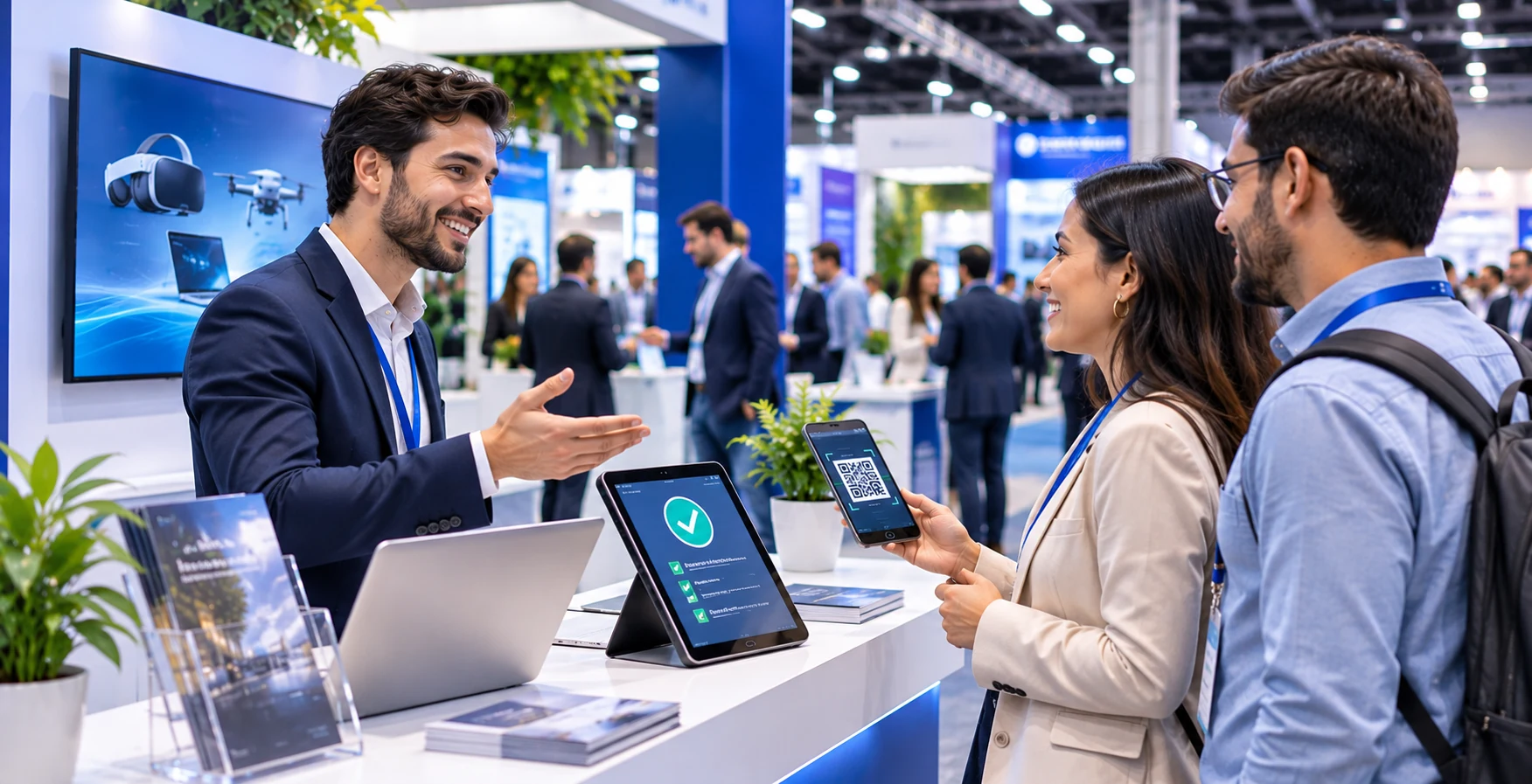


Trade shows bring businesses, industry professionals and potential customers together. But attracting exhibitors and filling an exhibition floor does not automatically create meaningful business opportunities.
Exhibitors invest in booth space, staff, travel, product demonstrations and promotional activities. They expect opportunities to connect with relevant attendees, showcase their solutions and generate qualified leads. Event organizers, meanwhile, need to create an exhibition experience that encourages attendees to explore exhibitors and gives participating companies measurable value.
The challenge is connecting these activities before, during and after the event.
Improving exhibitor engagement requires more than attractive booth designs or promotional giveaways. It involves helping attendees discover relevant companies, encouraging meaningful interactions, supporting lead collection and measuring exhibitor performance.
In this guide, we explore 12 practical strategies to improve exhibitor engagement at trade shows, the metrics organizers should track and how event technology can support the entire process.
What Is Exhibitor Engagement at a Trade Show?
Exhibitor engagement refers to the participation and interactions between exhibitors, event organizers and attendees throughout a trade show.
It involves two important dimensions:
- Exhibitor participation: How actively companies prepare their profiles, promote their participation, showcase products, manage booth teams and follow up with potential customers.
- Attendee engagement with exhibitors: How attendees discover companies, explore their offerings, visit booths, participate in demonstrations, schedule meetings and express interest in products or services.
For example, an attendee visiting a manufacturing trade show might search for industrial automation providers, explore their company profiles, bookmark relevant exhibitors and visit selected booths for product demonstrations.
Each activity creates an opportunity for an exhibitor to connect with a potential customer.
For event organizers, the objective is to create an environment where exhibitors receive relevant exposure and attendees can easily discover companies that match their interests.
Why Is Exhibitor Engagement Important?
Exhibitor engagement influences the experience of participating companies and the overall value of a trade show.
A well-organized exhibition should help exhibitors connect with relevant audiences rather than simply provide physical space to display products.
Here are 4 important reasons why organizers should prioritize exhibitor engagement.
1. Improve exhibitor satisfaction and retention
Companies want to understand what they gained from participating in an event. Better attendee discovery, useful interactions and transparent performance reporting help organizers demonstrate the value of exhibiting.
2. Create better attendee experiences
Attendees visit trade shows to explore solutions, compare products, meet industry experts and discover business opportunities. Relevant exhibitor information and easy booth navigation make these activities more productive.
3. Support qualified lead generation
Meaningful conversations help exhibitors understand attendee requirements and identify potential customers. Structured lead collection also makes it easier to prioritize follow-up.
4. Demonstrate sponsorship and exhibition value
Organizers can use exhibitor engagement information to understand participation patterns, demonstrate digital visibility and improve future sponsorship and exhibitor packages.
12 Ways to Improve Exhibitor Engagement at Trade Shows
1. Start Engaging Exhibitors Before the Trade Show
Exhibitor engagement should begin during the preparation stage, not when the exhibition opens.
Companies need enough time to prepare their profiles, promote their participation, train booth representatives and plan meetings with potential customers.
Create a pre-event exhibitor onboarding process that includes:
- Instructions for completing digital exhibitor profiles.
- Deadlines for uploading company logos and promotional materials.
- Guidance for adding products, brochures and demonstration videos.
- Booth numbers and exhibition floor information.
- Details about attendee networking and meeting opportunities.
- Lead retrieval instructions for booth representatives.
- Promotional materials for email and social media campaigns.
For example, an industrial automation company exhibiting at a manufacturing conference could announce a live robotics demonstration several weeks before the event.
Attendees researching automation solutions can discover the company, explore its products and plan a booth visit before arriving.
How Eventify helps: Eventify provides exhibitor profile management and digital event features that organizers can configure before the event. Exhibitors can add company information, booth details, products, brochures and promotional media to improve their visibility.
2. Create Complete and Informative Digital Exhibitor Profiles
An exhibitor's digital profile should give attendees a clear understanding of what the company offers and why they should visit its booth.
A basic company name and logo rarely provide enough information for attendees to make an informed decision.
Encourage exhibitors to include:
- Company description and industry.
- Product and service categories.
- Company logo and promotional banner.
- Product demonstration videos.
- Downloadable brochures and presentations.
- Website and social media links.
- Contact information.
- Booth number and location.
- Relevant product tags.
Consider a healthcare technology exhibition with companies offering hospital management systems, diagnostic equipment and patient monitoring solutions.
When exhibitors organize their profiles around these product categories, attendees can identify relevant companies more easily.
How Eventify helps: Eventify supports detailed exhibitor profiles containing company information, logos, banners, booth numbers, products, promotional videos, brochures and contact details. Exhibitors can also share coupons and deals through their profiles.
This creates a more informative digital exhibitor directory and gives attendees additional reasons to explore participating companies.
3. Make Exhibitor and Booth Discovery Easier
An exhibition may include hundreds of participating companies across multiple halls and categories. Without effective navigation, attendees can miss exhibitors that offer solutions relevant to their requirements.
Organizers should make it easier for visitors to find companies through:
- Searchable exhibitor directories.
- Product and industry categories.
- Consistent booth numbering.
- Interactive exhibition floor maps.
- Featured exhibitor placements.
- Digital company profiles.
- Bookmarking and favorites.
For example, an attendee looking for enterprise cybersecurity solutions should be able to explore relevant exhibitors rather than manually search the entire exhibition directory.
Interactive maps also help attendees understand where selected booths are located.
How Eventify helps: Eventify supports exhibitor profiles, featured listings, product information and interactive event maps. These capabilities help attendees discover participating companies and navigate the exhibition.
4. Use Promotional Offers to Encourage Booth Interactions
Promotional offers give attendees an additional reason to explore an exhibitor's products and interact with its representatives.
However, the most effective promotions are connected to the exhibitor's actual offering.
Examples include:
- Exclusive product demonstrations.
- Complimentary consultations.
- Downloadable industry reports.
- Product trials.
- Limited-time event offers.
- Technical assessments.
- Product comparison sessions.
For example, a SaaS exhibitor at a technology trade show could offer a free workflow assessment to attendees interested in improving business operations.
The offer encourages a conversation about the attendee's requirements instead of focusing entirely on distributing promotional merchandise.
How Eventify helps: Eventify allows exhibitors to include promotional materials, products, coupons and deals in their digital profiles. Organizers can encourage exhibitors to use these resources to make their listings more useful.
5. Introduce Gamification and Booth Discovery Challenges
Gamification can encourage attendees to explore more exhibitors instead of visiting only companies they already know.
Organizers can introduce exhibition challenges that reward attendees for participating in relevant activities.
For example, a trade show could create an industry discovery challenge where attendees explore exhibitors across 5 product categories.
A practical implementation could involve:
- Creating a list of participating exhibitors.
- Designing QR-based activities or configured engagement challenges.
- Assigning points for completing eligible activities.
- Encouraging attendees to explore different exhibition categories.
- Recognizing participants through rewards or leaderboards.
The challenge should encourage genuine exploration and interaction rather than collecting scans without meaningful engagement.
How Eventify helps: Eventify supports gamification features such as QR scan challenges, trivia and quest-based activities. Organizers can configure activities that encourage attendee participation and exploration throughout the event.
6. Encourage Pre-Booked Meetings Between Exhibitors and Attendees
Exhibitors should not have to depend entirely on unplanned booth visits to generate business conversations.
Pre-event meetings give companies an opportunity to connect with relevant prospects and prepare for more productive discussions.
Organizers can encourage exhibitors to:
- Define their ideal attendee profiles.
- Promote products and services before the event.
- Identify relevant attendees.
- Offer meeting opportunities.
- Share booth locations and meeting information.
- Prepare representatives for scheduled conversations.
For example, a cybersecurity company exhibiting at an enterprise technology conference may want to meet IT directors, security managers and enterprise decision-makers.
A scheduled meeting gives both parties an opportunity to discuss specific requirements rather than relying on a brief introduction at the booth.
How Eventify helps: Eventify supports attendee networking and exhibitor appointment requests. Its event matchmaking capabilities can also help attendees discover relevant professional connections based on shared interests.
7. Make Lead Capture and Qualification Part of the Exhibitor Experience
Collecting contact details is only the beginning of lead generation.
Exhibitors also need to understand why an attendee is interested, what problem they are trying to solve and whether there is a potential business opportunity.
Encourage booth representatives to collect relevant information such as:
- Product or service interest.
- Business requirements.
- Organization type.
- Purchase timeframe.
- Follow-up preferences.
- Notes from the conversation.
A simple qualification framework can help exhibitors prioritize contacts.
For example:
- High priority: An attendee has an immediate requirement and is evaluating solutions.
- Medium priority: An attendee has a relevant business need but expects to make a decision later.
- Low priority: An attendee is exploring the market without a defined purchasing requirement.
Information collection should be transparent and follow applicable privacy and consent requirements.
How Eventify helps: Eventify's Trade Show Lead Capture App supports QR-based lead scanning, configurable lead forms, lead information collection and exports. Exhibitors can also qualify collected leads and organize their follow-up activities.
Explore the Eventify Trade Show Lead Capture App to learn more.
8. Train Booth Staff to Have More Meaningful Conversations
A well-designed booth and an effective event app can attract attention, but the quality of the conversation often determines whether an interaction becomes a business opportunity.
Organizers should encourage exhibitors to prepare their booth representatives before the event.
Each team member should understand:
- The company's main products and services.
- Its ideal customer profile.
- The problems its solutions address.
- Questions to ask potential customers.
- How to demonstrate relevant products.
- How to capture and qualify leads.
- How to assign follow-up responsibilities.
Instead of beginning every conversation with a lengthy company introduction, a representative could ask:
"What business challenge are you hoping to solve at this exhibition?"
This creates a more relevant discussion and helps representatives understand the attendee's requirements.
9. Promote Product Demonstrations and Exhibitor Activities
Product demonstrations give attendees a practical reason to visit a booth.
A company displaying a product is not necessarily creating an engaging experience. Visitors should have opportunities to understand how the product works and how it addresses their requirements.
Encourage exhibitors to organize:
- Live product demonstrations.
- Product launches.
- Technical presentations.
- Interactive workshops.
- Expert consultations.
- Hands-on demonstrations.
- Product comparison sessions.
For example, an industrial equipment manufacturer could demonstrate how its machinery improves production efficiency during scheduled sessions.
Organizers can promote these activities through event announcements, exhibitor profiles and event communications.
How Eventify helps: Eventify supports digital exhibitor profiles, promotional media and event communication capabilities. Organizers can also link exhibitors to relevant event sessions, making it easier to connect companies with their associated presentations.
10. Use Relevant Event Notifications to Promote Exhibitors
Event notifications can help attendees discover exhibitors and activities that match their interests.
However, communication should be relevant and useful rather than repetitive.
Organizers can share notifications about:
- Featured exhibitors.
- Upcoming product demonstrations.
- Changes to booth locations.
- Exhibition activities.
- Scheduled networking opportunities.
- Relevant exhibitor promotions.
For example, attendees interested in industrial robotics could receive an announcement about an upcoming product demonstration, provided they belong to an appropriate communication group and their notification preferences allow it.
How Eventify helps: Eventify supports event announcements, push notifications and targeted communication capabilities. Organizers can use these tools to communicate relevant exhibitor information through the event app.
11. Measure Exhibitor Engagement During the Event
Exhibitor performance should not be evaluated solely by counting exhibition visitors.
Organizers need to understand how attendees discover companies, which profiles attract interest and how effectively exhibitors capture potential leads.
Useful indicators include:
- Exhibitor directory views.
- Individual exhibitor profile views.
- Exhibitor searches.
- Profile favorites.
- Leads collected.
- Scheduled and completed meetings.
- Promotional activity.
- Physical booth visits, when reliable measurement is available.
For example, an exhibitor receiving substantial digital profile views but very few leads may need to improve its product information or calls to action.
Another exhibitor may attract fewer profile views but generate more qualified business conversations.
These measurements tell different stories and should not be treated as interchangeable.
How Eventify helps: Eventify's Exhibitors Insights provides information such as exhibitor list views, profile views, searches, favorites, popular tags and top countries. Organizers can use available reports and exports to understand digital exhibitor discovery and identify engagement patterns.
Importantly, profile views and favorites indicate digital interest. They should not be presented as verified physical booth visits or confirmed sales opportunities.
12. Share Post-Event Exhibitor Reports and Collect Feedback
Exhibitor engagement should continue after the exhibition closes.
A post-event review helps participating companies understand their performance and gives organizers information to improve future editions.
An exhibitor performance report can include:
- Digital exhibitor profile views.
- Directory discovery activity.
- Search activity.
- Profile favorites.
- Leads collected.
- Qualified leads, where available.
- Meetings completed.
- Follow-up activity.
- Exhibitor feedback.
Organizers should also collect feedback through a structured survey.
Useful questions include:
- Did you connect with your target audience?
- Were attendees able to discover your booth?
- Which products attracted the most interest?
- Were the lead collection tools useful?
- What additional support would improve your next participation?
Use the findings to improve exhibitor onboarding, promotional activities, exhibition layouts and attendee communication.
How Eventify helps: Eventify's exhibitor analytics and reporting exports help organizers review digital exhibitor engagement and prepare performance reports. Exhibitor-specific profile statistics can also be made available through configured profile settings.
Which Exhibitor Engagement Metrics Should Trade Show Organizers Track?
A successful exhibitor engagement program needs measurable objectives.
Instead of relying on a single attendance figure, organizers should monitor discovery, interaction, lead generation and exhibitor satisfaction.
How to Calculate Exhibitor Engagement Metrics
Here are 3 practical calculations organizers and exhibitors can use.
1. Lead capture rate
Lead capture rate = (Leads captured ÷ Eligible booth interactions) × 100
Example:
An exhibitor records 80 meaningful booth interactions and collects 32 leads.
Lead capture rate = (32 ÷ 80) × 100 = 40%.
2. Qualified lead rate
Qualified lead rate = (Qualified leads ÷ Total captured leads) × 100
Example:
An exhibitor collects 50 leads, of which 20 meet its qualification criteria.
Qualified lead rate = (20 ÷ 50) × 100 = 40%.
3. Meeting completion rate
Meeting completion rate = (Meetings completed ÷ Confirmed meetings) × 100
Example:
An exhibitor confirms 25 meetings and completes 20.
Meeting completion rate = (20 ÷ 25) × 100 = 80%.
These are illustrative calculations, not industry benchmarks. Organizers should define measurement rules consistently and compare exhibitors with similar participation objectives.
How Event Technology Improves Exhibitor Engagement
Managing exhibitor information through spreadsheets, separate emails and disconnected lead collection tools can make exhibition operations difficult to coordinate.
An integrated event platform helps connect important exhibitor activities.
Digital exhibitor discovery: Company profiles, product information and searchable directories help attendees identify relevant businesses.
Attendee interaction: Networking, meetings, promotional information and event notifications create opportunities for exhibitors to connect with visitors.
Lead collection: QR-based lead retrieval and configurable forms help exhibitors collect and organize attendee information.
Performance measurement: Exhibitor analytics help organizers understand digital discovery and identify companies attracting attendee interest.
The value comes from connecting these activities into a coordinated event experience rather than managing each activity separately.
How Eventify Helps Improve Exhibitor Engagement at Trade Shows
Eventify provides event organizers with capabilities to manage exhibitor information, improve digital discovery, support attendee interactions and measure exhibitor engagement.
Its exhibitor management capabilities include:
- Digital exhibitor profiles: Display company descriptions, logos, booth numbers, products, promotional videos, brochures and contact information.
- Featured exhibitor listings: Highlight selected exhibitors above regular listings.
- Product showcases: Allow exhibitors to display products, descriptions, promotional materials and offers.
- Interactive event maps: Help attendees navigate exhibition spaces and locate booths.
- Gamification: Use configured QR challenges, trivia and quest-based activities to encourage attendee participation.
- Networking and meetings: Support professional connections and exhibitor appointment requests.
- Lead retrieval: Enable exhibitors to collect attendee information through QR-based scanning and configured lead forms.
- Exhibitor analytics: Review profile views, searches, favorites, directory activity and other available engagement information.
- Event communication: Share exhibitor announcements and relevant event updates with attendees.
By connecting exhibitor discovery, attendee interaction, lead retrieval and reporting, Eventify helps organizers manage more of the exhibitor engagement lifecycle within one event platform.
Explore Eventify's event management software to learn how it supports registration, attendee engagement, event operations and exhibitor management.
Frequently Asked Questions About Exhibitor Engagement at Trade Shows
1. How can event organizers improve exhibitor engagement at trade shows?
Organizers can improve exhibitor engagement through pre-event onboarding, complete digital exhibitor profiles, searchable directories, promotional offers, product demonstrations, networking opportunities, gamification, lead retrieval and post-event reporting.
2. How do you attract more attendees to exhibitor booths?
Use relevant product demonstrations, targeted promotions, searchable exhibitor profiles, interactive floor maps, scheduled meetings and event notifications. Give attendees a clear reason to visit each booth.
3. What are the most important exhibitor engagement metrics?
Important metrics include exhibitor profile views, directory views, searches, favorites, qualified leads, completed meetings, lead capture rates and exhibitor satisfaction.
4. How can exhibitors generate qualified leads at trade shows?
Exhibitors should define their target audience, prepare relevant demonstrations, ask qualifying questions, record attendee requirements and prioritize follow-up based on business relevance.
5. What is the difference between exhibitor engagement and lead retrieval?
Exhibitor engagement covers the complete process of discovery, interaction and relationship-building. Lead retrieval is one part of this process, focused on collecting attendee information and organizing potential business contacts.
6. How does event technology improve exhibitor engagement?
Event technology helps organizers manage exhibitor profiles, attendee discovery, booth navigation, networking, lead retrieval, event communication and engagement reporting through connected digital tools.
Final Thoughts
Successful exhibitor engagement is not determined by how many booths an event accommodates or how many visitors enter the exhibition hall.
It depends on whether exhibitors can reach relevant attendees, start meaningful conversations, capture useful leads and understand the results of their participation.
Event organizers that connect pre-event preparation, digital discovery, onsite interaction and post-event reporting can create a more valuable experience for exhibitors and attendees alike.
With the right engagement strategy and event technology, trade shows can become more than exhibition spaces. They can become effective environments for business connections, product discovery and long-term relationships.