

Introduction
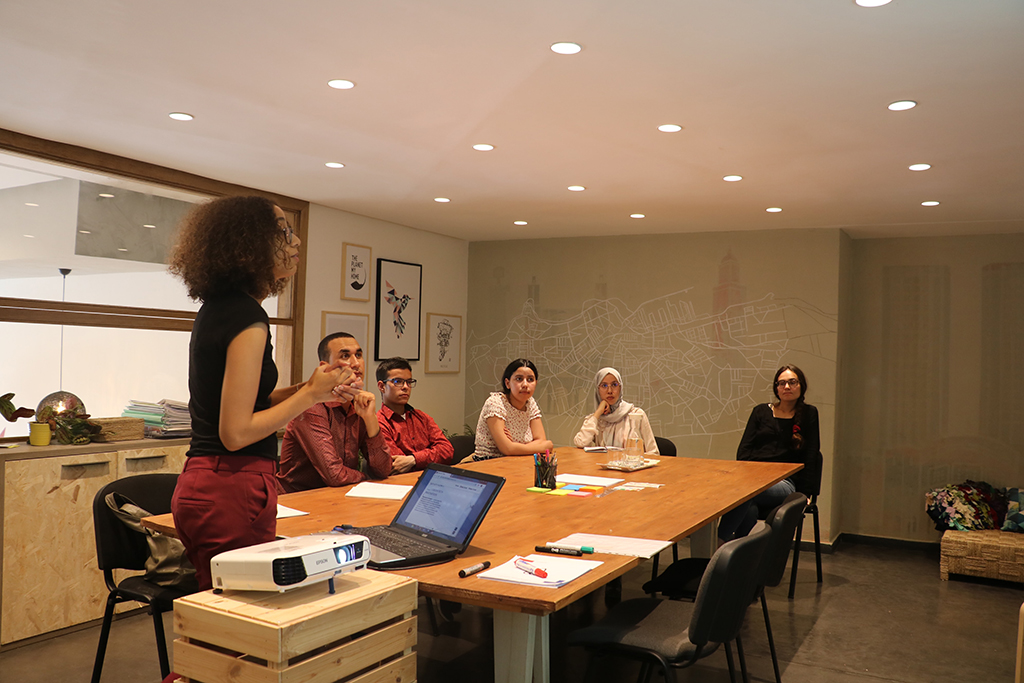
Seminars are interactive sessions led by an expert, focused on sharing knowledge and influencing thinking to bring attendees into meaningful conversations on a particular subject matter. From university halls to boardrooms, seminars are intentional learning moments that move people from passive knowledge to active mastery through interactions, expert insights, questions, etc.
This is why they are popular in various spheres, including academia, corporate workspaces, businesses, political meetings, and leadership. In this article, we will explore what a seminar is, the benefits for organisations, the different types of seminars, a step-by-step guide on how to plan one and the mistakes to avoid when planning one. Whether you are planning your first seminar or seeking knowledge to up your game, this article is for you.
What is a Seminar?
.jpg)
A seminar is a focused, intentional and interactive learning moment where a group of people explore a particular topic. It is usually led by an expert, such as a facilitator, guiding the discussions of the group through live demos, interactive Q & As, case studies, etc. They can be held in person or virtually in any field of discipline, from academia to government, with the duration ranging from 30 minutes to a full day. The primary goal of seminars is to move people from passive knowledge to active listening and dialogue.
Additionally, seminars prioritise attention to the complexity of the topic and audience needs rather than just delivering information or presenting a variety of ideas. For instance, a department in a university can hold a 4-hour seminar exploring recent breakthroughs and relevant theories in medicine. A company can hold a 45-minute seminar for new hires on how to use an AI tool for better productivity. The legal association in a town can hold a 2-hour seminar to teach real estate lawyers about new compliance rules in real estate.
Core Benefits: Why Seminars Work?
Seminars rank as one of the most effective learning methods for personal and professional development, because they focus on active listening and mastery. Unlike one-way presentations or speeches, they give room for dialogue, which bridges the gap between theory and practice. They transform otherwise passive knowledge into practical application. Below are some reasons why seminars work;
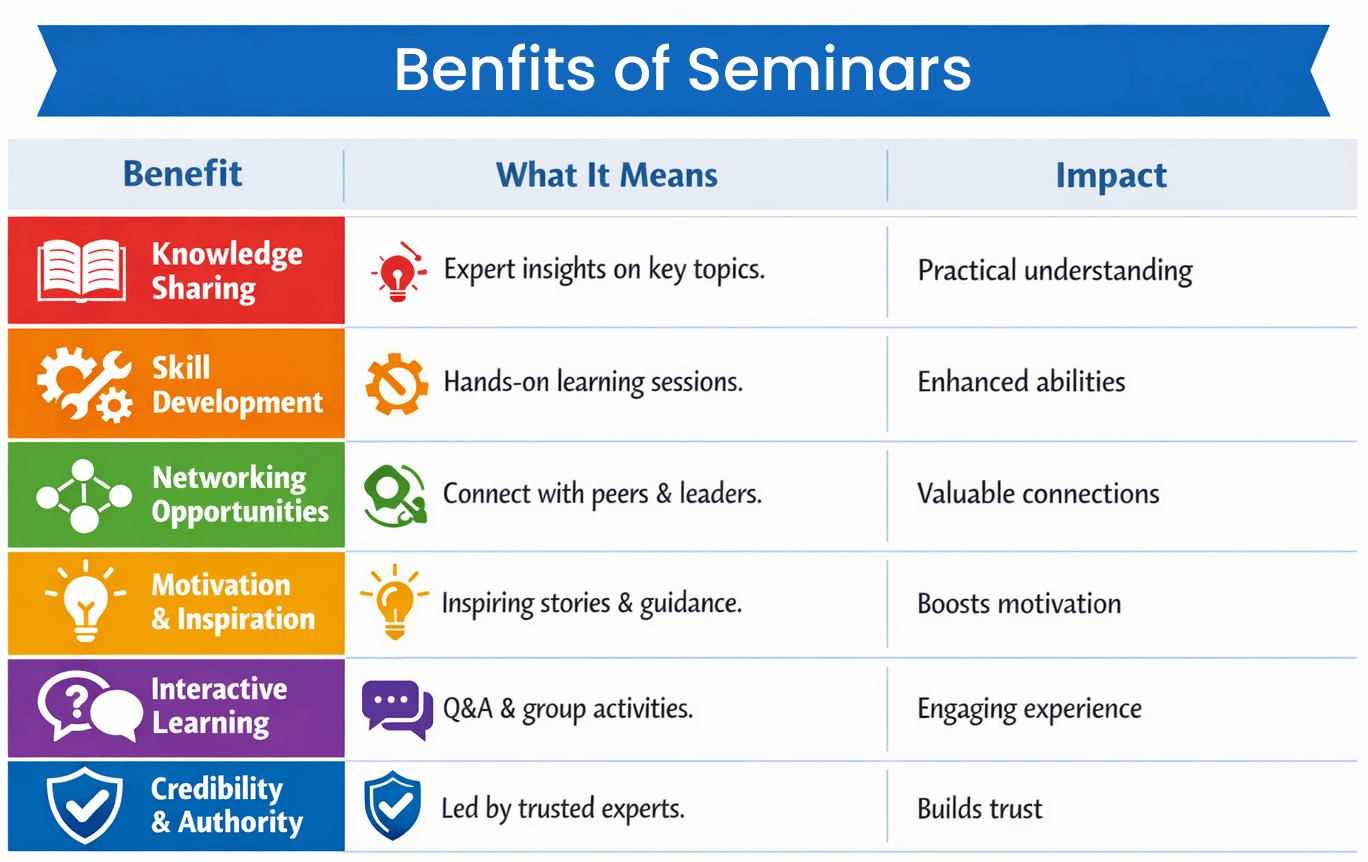
1. Focused Learning
Seminars encourage active participation through interactions and practical problem-solving, which forces attendees to be present. There’s no distraction or multitasking, so attendees can do deep work. This cognitive focus leads to them asking context-specific questions, where learning moves from theory to practice. It also encourages better knowledge transfer and retention.
2. Access to Experts
Another benefit of seminars is access to subject-matter experts who have real-world experience, not just theories. Unlike pre-recorded courses, where attendees cannot access their trainers, seminars encourage contextual learning. Attendees can ask experts how a specific concept applies to their business or careers, and get immediate feedback, which is valuable to everyone in the room.
3. Intentional Networking
Seminars create a mastermind effect by gathering like-minded people with a single goal in a room to discuss. Aside from the expert insights and knowledge exchange, attendees also bond over shared solutions and lightbulb moments. Most times, these relationships go on to influence careers and businesses, long after the seminar has passed.
4. Faster Alignment
Seminars are the fastest way to get everyone on the same page in organisations, academia, government, etc. Whether it’s a new compliance rule or a program, seminars communicate the how and why of the program, such that everyone understands. This ensures that attendees gain clarity and are aligned with the new development, leading to faster progress.
5. Stronger Accountability
Unlike large conferences and workshops, seminars are interactive and smaller, which makes participants more accountable. No one can hide behind anyone because there’s no barrier between the trainers and the participants. This increases attentiveness and engagement, and translates to more measurable outcomes for the organisers.
Key Types of Seminars?
Seminars are tailored to the audience and the purpose they serve. For instance, a seminar designed for academic researchers will differ from one designed for sales professionals. Although they come in different formats and structures, the primary goal remains bridging theory and practice and achieving better knowledge transfer and retention rates.
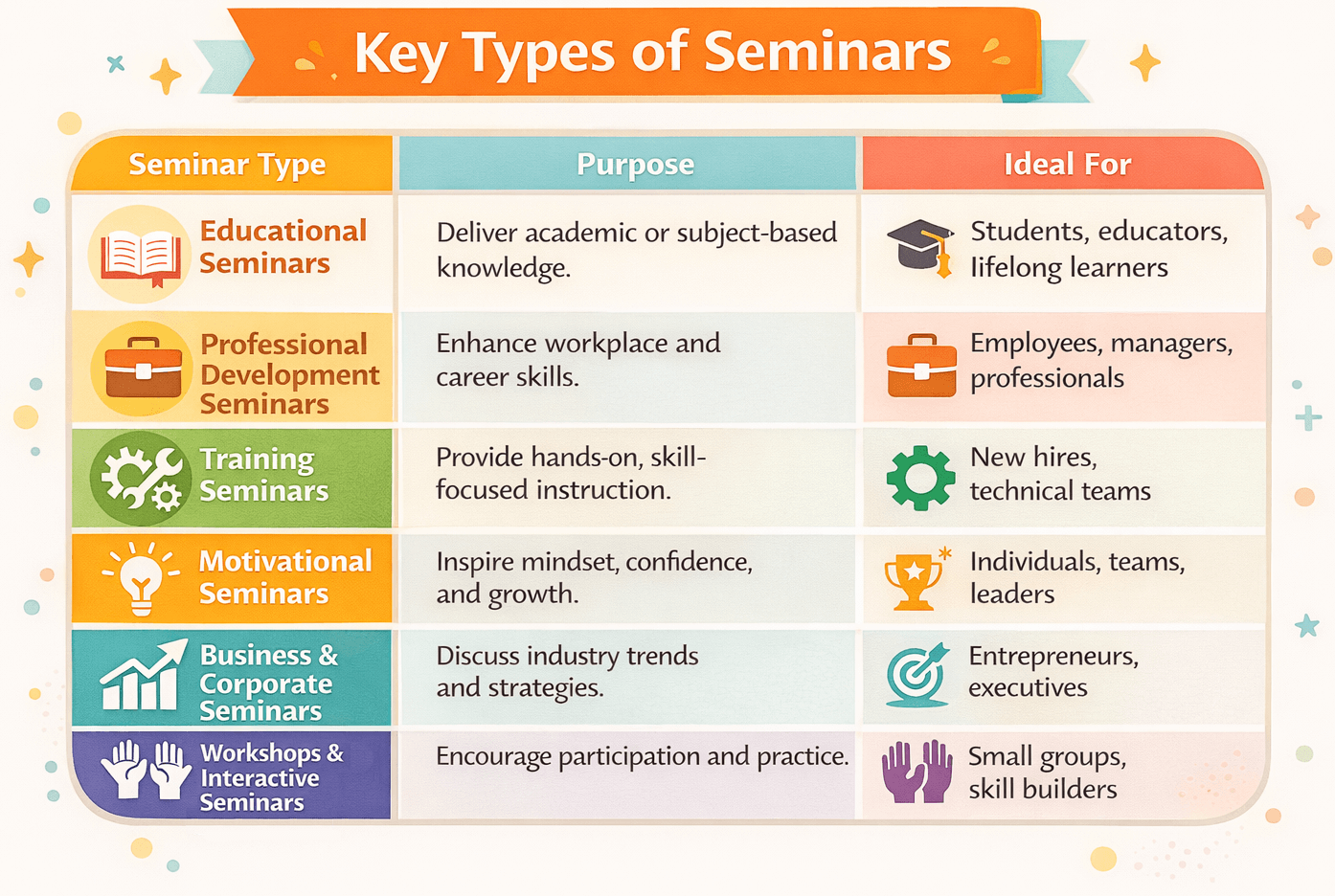
1. Academic Seminars
.jpg)
Academic seminars are the bedrock of learning in institutions, think tanks, research organisations, etc. They are usually led by professors and scholars, and focus on deconstructing theories and peer reviews. They use methods such as critical questioning and peer review, which often lead to the publication of research journals and policy papers. For instance, a real-life example is the Harvard Berkman Klein Centre session where scholars debate the laws and ethics of the Internet, and publish collaborative research papers.
2. Corporate Training
.jpg)
Corporate training seminars are organised internally within companies to get employees on the same page, train them or roll out new methods. They focus on making the new development clear to employees so they can get their buy-ins and ensure that everyone moves in the same direction. An example is a company training its sales team on a new CRM tool to increase their performance.
3. Professional Development
.jpg)
These seminars are focused on upskilling professionals to stay relevant in the marketplace. They help professionals understand market trends, build new skills, and keep moving upward in their workplaces. They are industry-focused and practical, and often come with certifications or continuing education credits. A notable example is the Google Ads Certification Seminars, which are free online training in various specialisations.
4. Leadership Seminars
.jpg)
These leadership seminars focus on soft skills such as emotional intelligence and communication for mid and high-level managers and executives. Other times, they can be industry-focused, such as exploring trends in the industry and forecasting the future, so these leaders can prepare their teams for peak performance. This is common in fields such as consulting, finance and technology. An example is the John Maxwell Leadership Certification Program.
5. Motivational Seminars
.jpg)
These seminars feature high-energy speakers who seek to inspire behavioural change and boost morale. They mostly focus on mindset and personal growth. Oftentimes, invited speakers share their lived experiences and actionable frameworks to help the audience achieve the growth they seek. For instance, Tony Robbins Unleash the Power Within uses psychological and mental activity to help entrepreneurs achieve new levels of growth.
6. Financial seminars
.jpg)
Financial seminars educate people on tax management, wealth creation, investing, etc. They focus on helping the average person understand both personal and business finance, and how to create a vision and plan for their money instead of spending as it comes. They are often organised by banks or financial professionals to build trust in the financial sector. For example, finance experts organise financial literacy seminars for private clients for better financial management.
7. Public Interest Seminars
.jpg)
These seminars focus on educating the public on general matters such as health, community, education, etc. They are usually organised by non-governmental organisations and government bodies, equipping the public with the knowledge and skills to act during natural disasters. A notable example is the Red Cross seminar, which teaches life-saving skills such as First Aid and CPR.
8. Technical Training Seminars
.jpg)
Technical training seminars are often held for professionals in IT, healthcare or engineering. These seminars provide hands-on skill or tool training for these professionals to elevate the quality of their work. For example, many IT companies host deep-dive technical sessions that allow their staff to troubleshoot different network problems in a controlled setting before applying the skills in real life.
9. Research seminars
.jpg)
Unlike general academic seminars, research seminars are technical environments where experts present and discuss their published data to their peers. The primary goal is to bring like-minded people together to problem-solve global challenges. For instance, CERN (European Organisation for Nuclear Research) hosts physics seminars where researchers across the globe gather to discuss particles and technology.
10. Train-the-trainer Seminars
.jpg)
These seminars are designed for educators, trainers, coaches, team leads, etc., where they learn both the technology and pedagogical methods of disseminating knowledge to their communities. This ensures quality control and better knowledge transfer across industries. For instance, Microsoft Certified Trainer (MCT) seminars, where experts are taught how to train others effectively.
Planning Your Seminar: Step-by-Step Guide
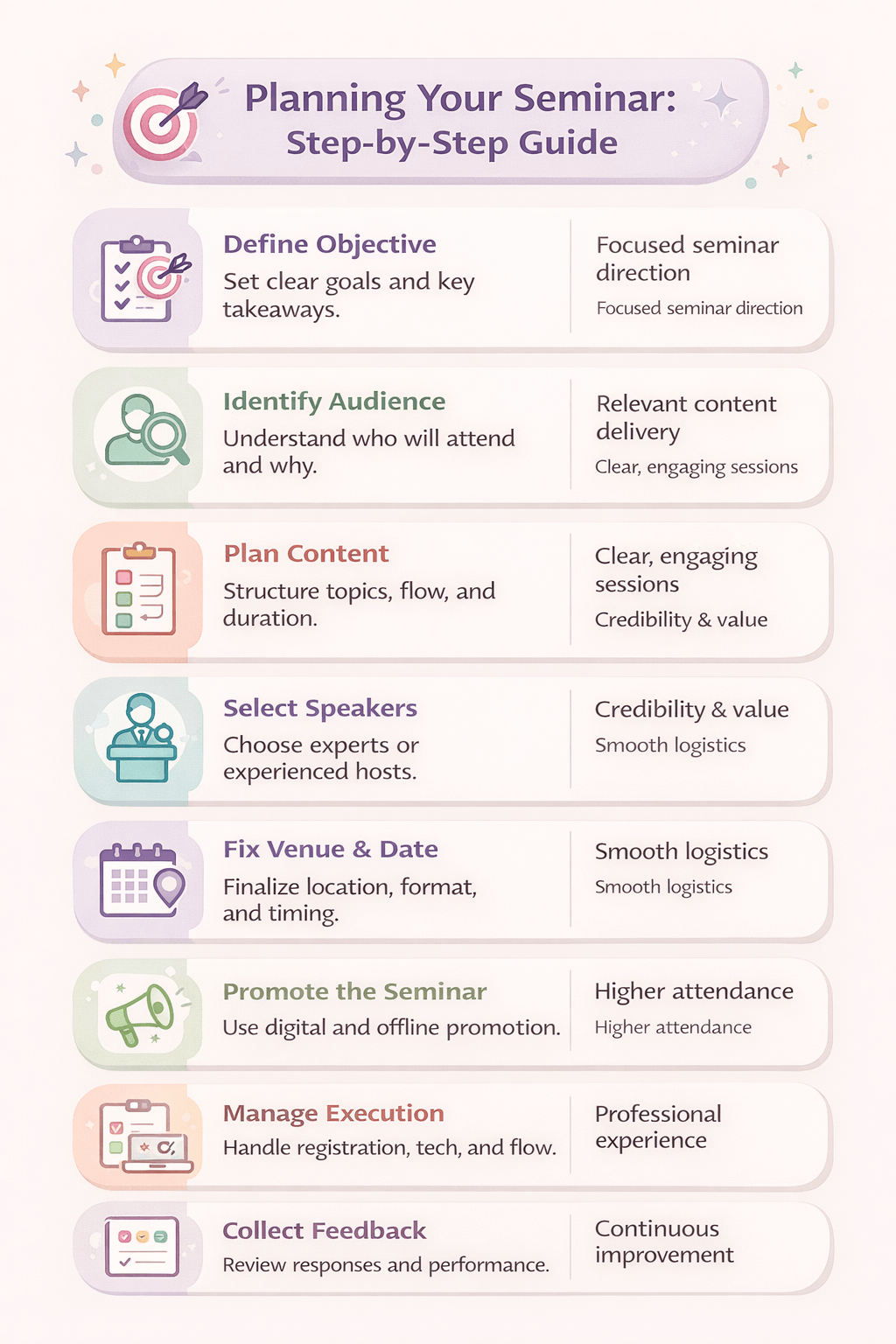
Planning a successful seminar requires more than booking a venue and sending out invites. A successful seminar is intentional and outcome-driven. This is why we have created a step-by-step guide on how to plan a seminar, whether it is academic, virtual, professional or corporate. This ensures you deliver the maximum value to your attendees.
1. Define your purpose
Every successful seminar starts with a purpose. Why are you organising the seminar? Is it to upskill some professionals, roll out a new strategy or solve a pressing problem? Without a clear purpose, the seminar turns into an information dump that attendees gain nothing from. Besides, defining the seminar's purpose will help you in choosing the topic, speakers and format. If you are unclear about your seminar's purpose, write one sentence that states the outcome you want to see by the end of the seminar. Avoid vague goals and focus on specific, measurable actions you want to see. This will guide your seminar from start to finish.
Pro Tip: Write your one-sentence outcome in this format: “By the end of the seminar, 80% of the attendees should be able to use this X tool or implement Y method (“X” stands for the name of the tool, while “Y” represents the name of the method.)
2. Identify your audience
Next is to identify and understand your audience. Seminars succeed or fail based on how well they meet the audience's needs. Understanding your audience's background, experience, and expectations helps you design a seminar that meets their needs. For instance, a seminar for IT professionals will be different from one for graduates who are looking to get into the corporate workspace. To get a full picture of your audience, you can conduct surveys or polls or analyse data from past seminars. As such, the content is fitted just right to their needs without overloading or boring them.
Pro Tip: Design your seminar content in a way that the lowest common denominator can understand without skimping on quality. Q & As and breakout discussions are effective ways to do this.
3. Choose the format and duration
Seminars can be physical, virtual or hybrid and range from 30 minutes to a full day, but the format and duration you choose should align with your seminar goals and audience. For instance, short seminars work for updates, while half-day seminars are for deep discussions or training. Virtual seminars or webinars require faster pacing, so choosing the best webinar software matters for a smooth, well-paced experience, while in-person seminars allow for longer discussions and networking. Hybrid seminars require extra planning to ensure remote participants are included.
Pro Tip: Break longer seminars into segments to allow for clear transitions and short breaks. This ensures attendees’ attention span isn't at risk.
4. Select the right speaker
When choosing a speaker for your seminar, look beyond topic knowledge and experience. Consider the person's delivery and facilitation skills as well. Can they deliver the message in a way that the audience understands? The best seminar speakers not only have expert insights but can also contextualise them in a way that applies to real-life situations. Poor facilitation can ruin the best content. Choose speakers not only on subject matter knowledge but also on communication style. In addition, brief them on your audience behaviour. If necessary, assign a moderator to manage the audience.
Pro Tip: Ask your speakers to use case studies or real-life scenarios. These anchor the concepts in proper reality contexts.
5. Design a clear agenda
A strong agenda is a roadmap for both participants and speakers. It maintains the flow of the seminar and prevents time overruns. It also ensures logical sequencing from start to finish. A good seminar agenda delivers value without feeling rushed. It makes participants feel engaged and enables the host to manage time and resources effectively. Use structured segments and break presentations with Q & As and discussions. Include time for interaction and networking. This reinforces learning and keeps the energy high.
Pro Tip: Share the agenda in advance with everyone. When they know what's coming, they show up more intentionally and manage time well.
6. Prepare the necessary materials
Lack of preparation of all necessary materials can derail even the best-planned seminar. For virtual seminars, test the technical setup before the seminar day. Check the audio, video, internet, and backup options. Invite your speakers and moderator to rehearse to identify and troubleshoot any difficulties they may face. For in-person events, confirm that the seats, acoustics, and amenities work perfectly. You may also want to get a venue that's accessible to people with physical disabilities. Assign clear roles to team members so you don't get overwhelmed with tasks.
Pro Tip: Murphy’s law states that anything that can go wrong will go wrong. As such, prepare contingency plans in case unexpected logistical or technical issues arise.
7. Promote the seminar
Even well-designed seminars will fail if they are not promoted. Promotion goes beyond sending out single invites to potential audience, but consistently showing them what they stand to gain through the right channels. Ensure your promotion messaging highlights who the seminar is for and the problem it solves for them. Use a mix of different channels such as emails, social media, event website and internal communication tools to share information. Create urgency by limiting seats or offering early registration incentives. For virtual seminars, be clear about the time, date and platform. For in-person seminars, clear directions matter as well.
Pro Tip: Consistent reminders increase attendance drastically. Promotion ensures you reach the right people who show up, prepared and engaged.
8. Follow up and measure impact
A seminar’s real value doesn’t end with the seminar. You need to strategically follow up and measure impact because this transforms participation into data that can inform future events. Within 24- 48 hours after the event, send a follow-up email sharing key takeaways, recordings, slides, etc. You can also include what attendees should apply immediately. This reinforces learning and retention. Then, collect feedback. Ask questions about content, pacing, speakers, etc., and combine both quantitative and qualitative metrics to get a full picture. The data will provide insights for improvement for future seminars.
Pro Tip: Focus on learning, retention, and structure when measuring impact. This ensures subsequent seminars are better and more focused on learning outcomes.
Common Seminar Mistakes and Solutions
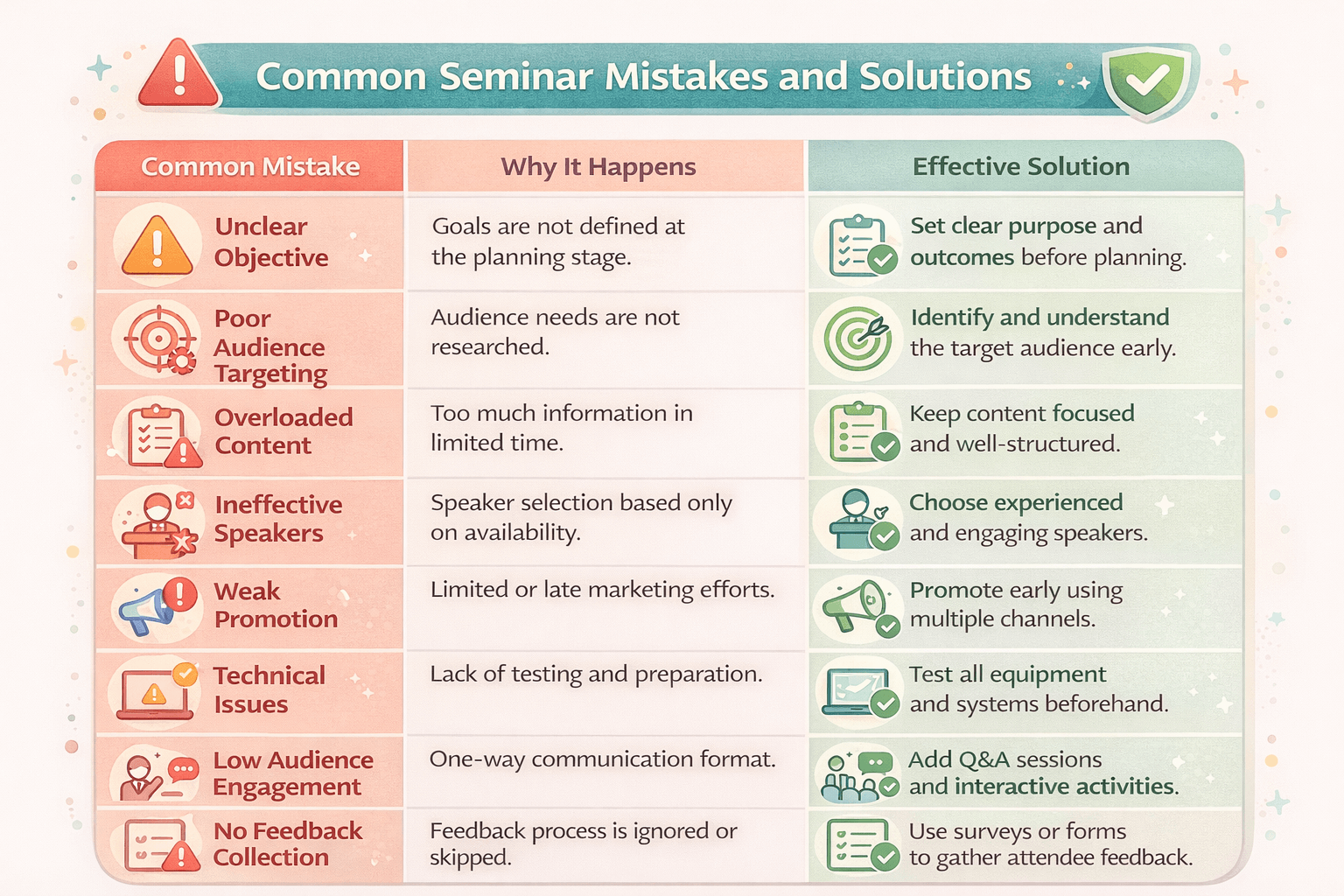
No matter how well-designed your seminar is, anything can still go wrong. However, it’s up to you to cross all t's and dot all i’s to reduce the chances of mistakes. Mistakes often cause speakers and attendees to lose trust in the seminar, which may affect future engagements. However, some of these mistakes can be prevented. Below are some common seminar mistakes, how they can impact the seminar and practical seminar solution.
1. Unclear purpose
A seminar that lacks a clear purpose turns into a long, unfocused conversation. Attendees struggle to understand what the seminar is all about or how they can apply it in real-life situations. This leads to disengagement and poor retention.
Solution: Define your seminar’s purpose clearly before planning anything else. State what participants should be able to gain at the end of the seminar. Let this guide your topic selection and speaker choice.
2. Content overload
Covering too much information in one seminar overwhelms participants and reduces retention rates. It makes attendees lose cognitive focus and leaves little room for reflection or discussion. This defeats the purpose of the workshop at the end of the day.
Solution: Edit your seminar agenda to focus on the core concepts and build interaction around them. Focus on depth over breadth. Break content into manageable segments and allow time for reflection and discussion.
3. Lack of application
Another common mistake with seminars is being too theoretical. The goal of a seminar is to help attendees bridge the gap between theory and practice. If they find it difficult to apply the information to their daily lives, they will struggle to appreciate the seminar’s value.
Solution: For every concept presented, include a real-world case. Explicitly state how attendees can use the information, even right there in the seminar.
4. Technical issues
Unreliable microphones and poor internet connections can disrupt the seminar and frustrate everyone - attendees, speakers, and hosts, especially in virtual or hybrid seminars.
Solution: Test all technology in advance. Have backup options for everything. Rehearse with your team and speakers so everyone is on the same page. Have a dedicated IT professional to manage the setup and troubleshoot issues quickly on the seminar day.
5. No follow-up
Ending a seminar without follow-up or impact measurement risks long-term value. Without feedback, you won’t be able to tell what to improve for future seminars. Also, some attendees might find it difficult to remember what they learnt with a follow-up.
Solution: Share recordings, slides and summaries with your attendees after the seminar. Also, collect their feedback using surveys or personal interviews and use both qualitative and quantitative metrics.
Try Eventify To Make Your Next Seminar Successful
From registration to engagement to post-event insights, seminars require a streamlined execution to be successful. This is where Eventify comes in. Eventify is an all-in-one event management platform that helps you centralise every part of your seminar so nothing falls through the cracks. With Eventify, you can create branded websites to manage attendee registration and ticketing, publish speaker profiles, and publish notifications to keep attendees informed.
During the seminar, you can use engagement tools to foster networking among your attendees, especially if it’s hybrid. After the seminar, you can check the analytics to measure participation and impact, turning your seminar into actionable insights for future events. If you aim to host outcome-driven and engaging seminars, Eventify offers all you need to do that.
Seminars promote shared learning, provide direct access to subject-matter experts, enable faster networking and alignment within organizations, and encourage participant accountability. These factors help improve knowledge retention and ensure learning outcomes are measurable.
Seminar durations can range from 30 minutes to a full day, depending on the topic, format, and audience. Short seminars are ideal for updates, while longer sessions are better for in-depth training and discussion.
Successful seminar planning includes defining a clear objective, understanding the target audience, choosing the right format and speaker, creating a detailed agenda, preparing materials in advance, and promoting the event with proper follow-up to measure impact.
Seminars are typically smaller, more interactive, and focused on discussion, whereas conferences are larger and emphasize presentations. Seminars encourage participation and accountability, while conferences expose attendees to multiple speakers and diverse topics.
Yes. Seminars can be conducted in person, online, or in hybrid formats. Virtual and hybrid seminars require thoughtful planning, reliable technology, and engagement strategies to ensure equal participation for both on-site and remote attendees.
.png)