

Introduction
Getting people to attend an event is only part of the job. The bigger challenge is giving them reasons to participate, connect with other attendees, ask questions and stay involved throughout the experience.
A conference can have experienced speakers and useful sessions but still struggle with audience participation. Attendees may listen without asking questions, leave networking opportunities unused or forget to complete feedback surveys. For organizers, this makes it difficult to understand what worked and what needs to change.
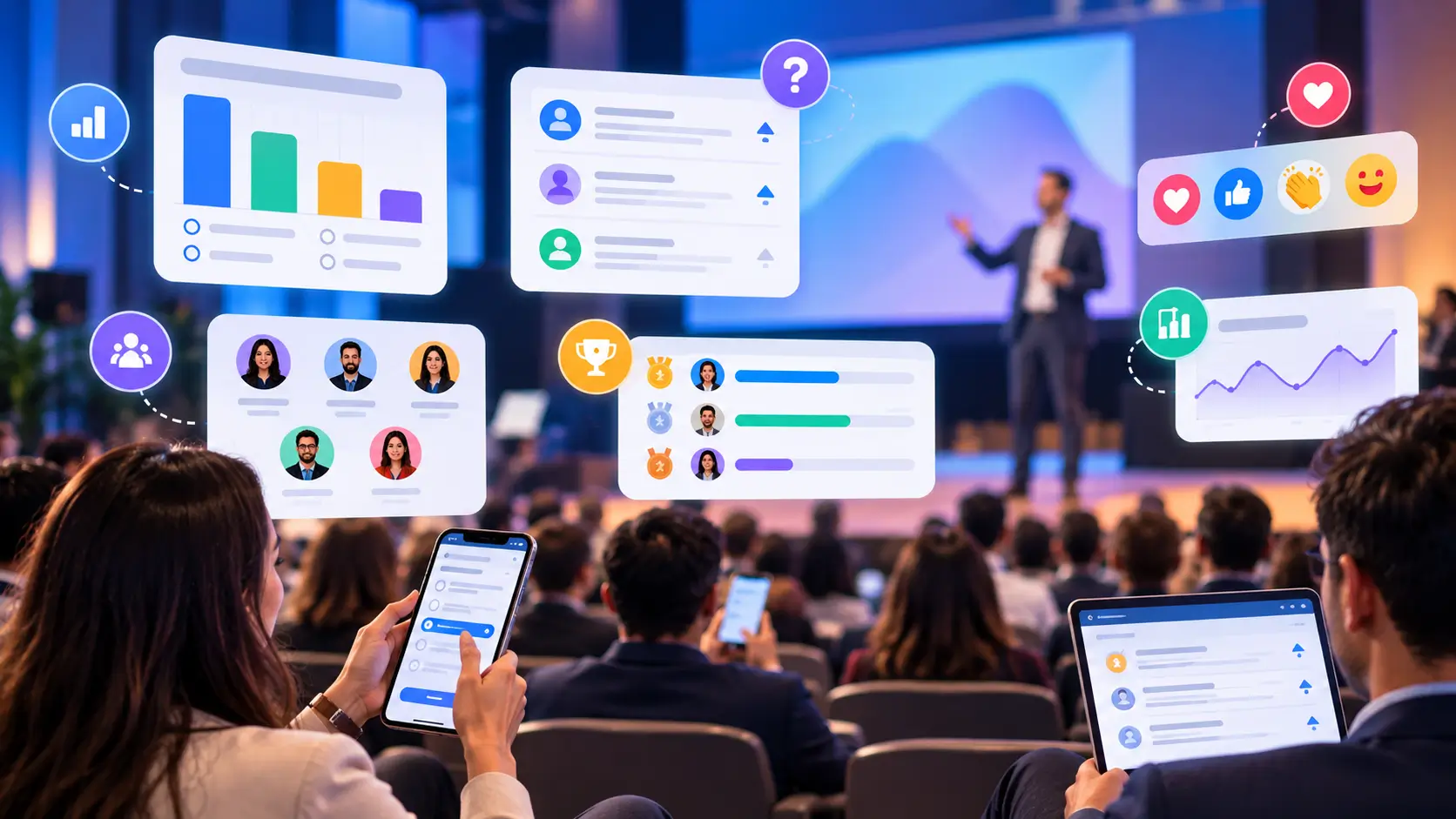
An audience engagement platform can help address these problems by giving attendees ways to participate through live polls, Q&A, quizzes, networking, messaging, community discussions and feedback activities.
However, not every platform offers the same capabilities. Some tools focus on interaction during presentations, while others support engagement across the entire event journey.
Choosing the right audience engagement platform means understanding your event goals, identifying the features that solve real problems and evaluating how easily attendees and organizers can use them.
This guide explains what to look for in an audience engagement platform, which questions to ask vendors and how to determine whether a solution fits your event.
What is an audience engagement platform?
An audience engagement platform is software that helps event organizers create opportunities for attendees to interact with speakers, content, other participants and the event itself.
Depending on the product, these interactions may include:
- Live polls, quizzes and audience response activities.
- Questions and answers during presentations.
- Attendee networking, messaging and meeting scheduling.
- Personalized agendas and session feedback.
- Community discussions and social feeds.
- Gamification, challenges and participation activities.
- Surveys and engagement reporting.
The term covers different types of software. A specialist audience response system may focus on polls, quizzes and Q&A during a presentation. A broader event engagement platform may combine these activities with networking, an event app, attendee communication and post-event feedback.
Neither approach is automatically better. The right choice depends on what your event needs and how many separate tools your team wants to manage.
1. Start with the audience engagement problem you need to solve
Before comparing audience engagement platform, identify the specific problem you want to address. “Improve engagement” is a useful objective, but it is too broad to guide a software purchase.
Consider the problems your team experiences at events.
Attendees listen but rarely participate
If sessions are mostly one-way presentations, look for live polls, quizzes, word clouds and Q&A features. These activities give attendees different ways to contribute without requiring everyone to speak in front of a room.
For example, a speaker could ask attendees to vote on a challenge they face at work, then use the results to guide the discussion.
Attendees struggle to connect with the right people
Networking requires more than placing people in the same venue. Attendees need ways to identify relevant contacts, start conversations and arrange meetings.
Look for attendee profiles, messaging, matchmaking and meeting scheduling if networking is an important outcome of your event.
Engagement drops between sessions
Attendees may participate during a keynote but have little reason to interact with the event outside scheduled sessions.
Depending on your audience, a community feed, discussion groups, event updates or gamification may encourage people to remain involved throughout the event.
Organizers cannot tell which activities worked
Attendance figures alone do not explain whether people found sessions useful or participated actively.
Look for relevant engagement reports, session ratings, surveys and export options. Confirm exactly which metrics the platform records and whether those reports are available in the plan you are considering.
Choose 2 or 3 primary goals before evaluating vendors. This will help you distinguish essential features from additions that may not improve the attendee experience.
2. Decide whether you need a specialist tool or a complete event engagement platform
One of the most important decisions is whether your event needs a focused interaction tool or a broader platform.
A specialist audience engagement tool may be sufficient when your main requirement is collecting responses during presentations. It may offer live polls, quizzes, anonymous questions, word clouds and presentation integrations.
A broader attendee engagement platform may be a better fit when your requirements extend beyond individual sessions.
For example, a multi-day conference may need:
- A personalized agenda that attendees can access throughout the event.
- Networking and meeting scheduling.
- Messaging between attendees.
- Live polls and Q&A during sessions.
- Event updates and community discussions.
- Session ratings and post-event feedback.
Using separate tools for every activity can introduce additional work. Organizers may need to manage multiple accounts, explain different access methods, move data between systems and troubleshoot several platforms during the event.
An all-in-one solution may reduce that fragmentation, but it is not automatically the right choice for every event. A small workshop that only needs live polling may not benefit from a larger platform.
Compare the complete workflow, the cost and the effort required from your team before making a decision.
3. Evaluate features across the entire event journey
A useful audience engagement platform should support the activities that matter before, during and after your event.
Before the event: Help attendees prepare
Engagement can begin before people arrive at the venue.
Depending on your event, useful capabilities may include:
- Personalized agendas: Help attendees find relevant sessions and organize their schedules.
- Attendee profiles: Make it easier to identify people with shared professional interests.
- Networking tools: Allow participants to discover contacts and arrange meetings.
- Event communication: Share schedule changes, important instructions and reminders.
- Easy onboarding: Explain how attendees can access the platform and use its features.
The objective is to help attendees arrive with a clearer idea of what they want to learn, whom they want to meet and which activities matter to them.
During the event: Give people reasons to participate
During a session, an audience engagement platform should make participation straightforward for both attendees and speakers.
Live polls and quizzes can help speakers check understanding, collect opinions or introduce a discussion.
Live Q&A gives attendees a way to submit questions. For larger sessions, ask whether moderators can review submissions, manage duplicate questions and prioritize relevant topics.
Networking and messaging can help participants continue conversations beyond the sessions they attend.
Community discussions and gamification may encourage interaction across the event, provided they support a clear objective rather than simply adding more activity.
Event updates can help organizers communicate changes to schedules, rooms or other practical details.
Not every event needs every feature. A technical conference may prioritize questions and professional networking, while a training workshop may focus on quizzes and feedback.
After the event: Turn participation into useful feedback
The event experience should not end when the final session finishes.
Session ratings and surveys can help organizers understand what attendees found useful. Engagement reports may help identify which activities attracted participation and which need improvement.
If the platform supports data exports or integrations, organizers may also be able to move approved information into their existing reporting or follow-up workflows.
Before choosing a audience engagement platform, confirm which reports it actually provides. A vendor offering analytics does not necessarily provide every metric your team wants to measure.
4. Make participation easy for attendees
A platform can have useful features and still see low adoption if attendees find it difficult to use.
Consider the steps required to participate in a live poll, submit a question or contact another attendee.
Do participants need to download an app, create an account, enter a code or move between different tools? Is it clear where to find the relevant feature? Can someone who arrives late understand how to join?
These details matter because attendees are already managing sessions, conversations, travel and other event activities.
During a product demo, test the attendee experience on the devices your audience is likely to use. Check whether the interface is clear, the instructions are easy to follow and the main activities require unnecessary steps.
Accessibility deserves attention too. Consider readable text, clear instructions, captioning or translation needs, and alternative ways to contribute for people who may not be comfortable speaking in front of a large audience.
If anonymous Q&A is important, ask how anonymity works and what information moderators can see.
Also confirm internet requirements. Do not assume a platform supports offline participation simply because it has a mobile app. Ask which functions require connectivity and what happens if the venue network becomes unreliable.
5. Check moderation, privacy and data ownership
Audience interaction creates opportunities for useful discussions, but organizers also need appropriate controls.
For live Q&A, ask whether questions can be moderated and whether the event team can remove inappropriate submissions. If the platform includes community discussions or social feeds, understand what controls are available for user-generated content.
Data handling is equally important.
Before selecting a platform, ask:
- What attendee information does it collect?
- Who can access that information?
- How long is the data retained?
- Can organizers export or delete the information?
- What security and privacy documentation is available?
- What controls apply when information is shared with sponsors or exhibitors?
The answers should be consistent with your organization's policies and the privacy requirements applicable to your event.
Sponsor engagement deserves particular care. A platform may help sponsors interact with attendees, but that does not automatically mean sponsors should receive personal attendee information. Confirm what information is shared, for what purpose and under what consent arrangements.
6. Evaluate integrations and the work required from your team
An audience engagement platform should fit your existing event operations.
Depending on your requirements, relevant integrations may include event registration systems, event apps, presentation software, virtual meeting platforms, CRM tools and reporting systems.
However, the word “integration” can mean different things.
A native integration may exchange information automatically. Another workflow may require a manual export, a spreadsheet import, a third-party connector or custom development.
Ask the vendor to explain which method applies to your specific use case, whether it costs extra and who is responsible for maintaining it.
You should also consider the work required to operate the platform.
Who creates polls and surveys? Who manages attendee permissions? Who moderates questions? Who trains speakers and reviews reports?
If your team is already stretched on event day, a solution that requires extensive manual setup may create more work than expected.
Ask for a demonstration using a realistic example from your event rather than a generic product tour.
7. Choose a platform that fits your event format
The requirements for a small workshop are different from those of a large conference or trade show.
Conferences and professional events
These events may benefit from live Q&A, session feedback, personalized agendas, networking and messaging.
Trade shows and exhibitions
Exhibitor interaction, sponsor participation, attendee networking and connections to lead-related workflows may be more important. If lead retrieval is required, verify that capability separately rather than assuming every engagement platform includes it.
Corporate meetings and training
Polls, quizzes, knowledge checks, surveys and discussion activities may help facilitators understand whether participants are following the content.
Virtual and hybrid events
Remote and in-person attendees should have clear ways to participate. Ask how the platform handles live questions, polls, networking and access to event information across different formats.
In every case, confirm the expected attendee capacity, concurrent session limits, device requirements and any feature restrictions that apply to your plan.
Ask the vendor to demonstrate the scenario you actually plan to run.
8. Compare total cost, not just the starting price
Audience engagement platform pricing can depend on attendee numbers, event frequency, available features, response limits, integrations, branding and support.
A low starting price may not include everything you need. A larger platform may also be unnecessarily expensive if your event only requires a few interactive activities.
When comparing quotes, include:
- The subscription or event license.
- Attendee, response or usage limits.
- Required add-on features.
- Integration and implementation costs.
- Branding options, if needed.
- Support during setup and the live event.
- Renewal terms and any additional charges.
If you are considering several separate tools, include the operational effort required to manage them.
Ask each vendor to price the same set of requirements. This makes the comparison more meaningful than comparing headline prices alone.
9. Use a scorecard to compare audience engagement platforms
After shortlisting vendors, use a consistent evaluation method instead of relying on product demos or feature lists alone. Score each audience engagement platform against the requirements that matter most to your event.
Rate each vendor from 1 to 5 for every criterion, then apply the suggested weights to compare the results. Use the same criteria for every vendor to make the comparison fair.
Before comparing overall scores, eliminate any vendor that fails a critical requirement, such as a necessary integration, privacy condition or attendee capacity limit. A high score should not compensate for a feature your event cannot operate without.
These weights are a suggested starting point, not an industry benchmark. Adjust them to reflect your event's priorities.
10. Measure whether audience engagement is improving
Selecting a audience engagement platform is only the beginning. You also need a way to assess whether it is helping attendees participate.
Start by defining the outcomes you want to measure.
Platform adoption
How many eligible attendees accessed or activated the platform?
This can help you understand whether the experience reached its intended audience, although adoption alone does not prove meaningful engagement.
Poll participation
How many attendees responded to each poll compared with the number invited or present for that activity?
Compare results across sessions where the circumstances are similar.
Q&A activity
How many questions were submitted, answered or upvoted? Which topics generated recurring questions?
These signals can help speakers identify where attendees want more explanation or discussion.
Session feedback
How many attendees completed session ratings or surveys? Which sessions received useful feedback?
Consider response rates as well as the comments themselves.
Networking activity
If the platform measures these activities, review the number of connections or meetings made and whether those activities align with your event goals.
Repeat participation
Did attendees continue participating across multiple sessions or event days, or did interaction decline after the opening session?
The most useful metrics depend on the event. A high number of clicks does not necessarily mean attendees found the experience valuable.
Combine platform data with feedback from attendees, speakers and the event team. The goal is to understand what helped people participate and what should change next time.
11. Questions to ask before choosing an audience engagement platform
Before signing up, use this checklist during vendor demonstrations.
- Can you demonstrate the attendee journey we plan to use?
- Which features are included in the quoted plan, and which cost extra?
- Can attendees participate through a browser, or is an app download required?
- What moderation, anonymity and accessibility controls are available?
- Which integrations are native, and which require manual exports or custom work?
- What engagement metrics can organizers view and export?
- How is attendee data stored, retained, shared and deleted?
- What are the attendee, response and concurrent-session limits?
- Which features require an internet connection?
- What support is available before and during the event?
- Can you provide a relevant customer example and explain how its results were measured?
The answers should help you assess the platform against your actual requirements rather than relying on a long list of advertised features.
How Eventify supports audience engagement at events
For organizers who need more than live polls and Q&A, Eventify is worth evaluating as a broader event engagement solution.
Eventify's event app and attendee engagement capabilities include features such as live polls and Q&A, attendee networking and matchmaking, chat and meetings, social feeds, community forums, gamification, session ratings, surveys and event updates. The specific capabilities available should be confirmed against your event requirements and product configuration.
The advantage of evaluating a broader event platform is that engagement activities can form part of the wider attendee experience rather than being managed as completely separate activities.
For example, an organizer planning a multi-day conference may want attendees to access event information, connect with other participants, take part in session discussions and provide feedback through the event experience.
Start by mapping your objectives to the features you will actually use. Then ask the Eventify team to demonstrate the relevant attendee and organizer workflows, along with the reporting available for your event.
Explore Eventify's Attendee Engagement platform and Event App to review the available capabilities.
Frequently asked questions
What is the difference between an audience engagement platform and an event app?
An audience engagement platform helps people participate through activities such as polls, Q&A, quizzes, surveys and networking. An event app may offer these capabilities alongside schedules, attendee information, messaging and event updates. The exact overlap depends on the product.
What features should an audience engagement platform have?
Start with your event goals. Common features include live polls, Q&A, quizzes, surveys, networking, messaging, community discussions, gamification, reporting and integrations. Not every event needs every feature.
Are audience engagement tools different from audience response systems?
Audience response systems typically focus on collecting responses during presentations through polls, quizzes and questions. Audience engagement tools may cover those activities as well as networking, community interaction and engagement before or after sessions. Vendors use these terms differently, so compare their actual capabilities.
How can event organizers measure audience engagement?
Depending on the platform, useful metrics may include adoption, poll response rates, Q&A submissions, session ratings, survey completion, networking activity and repeat participation. Interpret these numbers alongside attendee feedback and event objectives.
Can an audience engagement platform support hybrid events?
Some platforms support in-person, virtual and hybrid events. Capabilities differ, so confirm how remote attendees can participate in polls, Q&A, networking and other activities. Test the experience across the formats you plan to support.
Do attendees need to download an app?
That depends on the platform and its configuration. Some tools allow participation through a browser, link or code, while others use an event app for broader functionality. Test the joining process before choosing a solution.
How much does an audience engagement platform cost?
Pricing may depend on attendee numbers, event frequency, features, response limits, integrations and support. Request a quote based on your actual requirements and compare the total cost rather than the starting price alone.
Is a dedicated polling tool enough for a conference?
It may be enough if your main requirement is interaction during presentations. If you also need networking, personalized agendas, attendee messaging, community features or post-event engagement, compare it with a broader event engagement platform.
Final checklist: Choose based on your event goals
The right audience engagement platform is not necessarily the one with the longest feature list. It is the one that helps attendees participate, gives organizers useful feedback and fits the way the event operates.
Define your engagement goals, compare specialist tools with broader platforms, test the attendee experience, verify integrations and privacy requirements, and agree on how you will measure results.
A clear selection process will help you choose software that supports the event experience you want to create, rather than adding features that attendees may never use.
.png)