How to Plan Hybrid Events That Triple Your Reach | Part 1



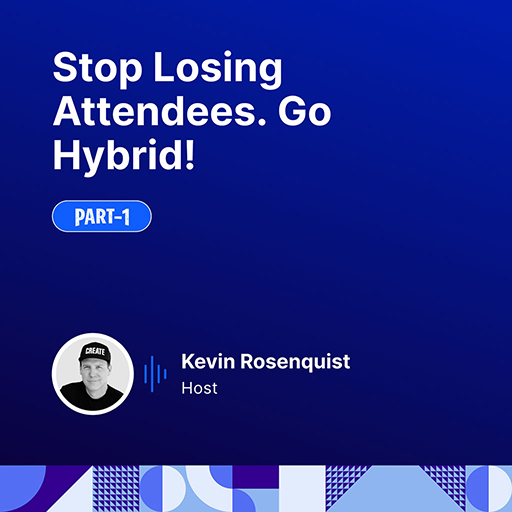
How to Plan Hybrid Events That Triple Your Reach | Part 1
Your competitors are reaching 3x more attendees while cutting costs.
Here's how.
In Part 1 of the Hybrid Event Playbook, host Kevin Rosenquist breaks down everything you need to know to plan a successful hybrid event in 2026—from strategy to execution.
📌 What You'll Learn:
✅ Why 97% of event professionals say hybrid is essential (and why you can't ignore this).
✅ The proven 6-month planning timeline that sets you up for success.
✅ How to design unique experiences for BOTH in-person and virtual audiences.
✅ Cost-saving strategies that reduce expenses.
✅ Data-driven insights: why hybrid events get 2-3x more attendees.
✅ Accessibility best practices that make your events truly inclusive.
🔥 Coming in Part 2: Real-world examples from Coachella, Microsoft, Apple, and CES—plus the exact engagement tactics they used to keep both audiences hooked.
Subscribe so you don't miss it!
Hybrid Events in 2026: Why They Matter and How to Plan One (Part 1) - Full Transcript | Event Trends by Eventify
0:01 Hey there, and welcome back to Event Trends by Eventify.
0:03 I'm Kevin Rosenquist, and today we're kicking off a two-part series on hybrid events.
0:07 And trust me, this is going to be packed with practical advice you can actually use.
0:15 Now look, I know hybrid events have been around for a few years now, but what I'm seeing in 2026 is that they've evolved way beyond those early pandemic Zoom meetings.
0:24 We're talking about events that seamlessly blend in-person energy with digital accessibility, creating experiences that are more inclusive, more engaging, and honestly, more profitable than traditional formats.
0:37 So, in part one today, I'm walking you through the why and the how.
0:41 Why hybrid events matter more than ever, and how to plan one that actually works.
0:46 Then in part two, I'm bringing you real-world examples from events like Coachella, Microsoft, and Apple, plus specific tactics for keeping people engaged and overcoming those inevitable challenges.
0:59 All right. Well, let's dive in.
1:01 So, first, let's talk about why hybrid events are such a big deal.
1:05 Because some of you might be thinking, "Kevin, didn't we already do this? Can't we just go back to normal in-person events?"
1:11 Well, here's what the data tells us, and these numbers are pretty eye-opening.
1:15 97% of event professionals, that's basically everyone in our industry, believe hybrid events will be an essential part of the future.
1:25 And get this, 80% of event planners have either already hosted or are planning to host a hybrid event.
1:30 This isn't a temporary trend. This is a new baseline. But why?
1:35 Well, let me break down the benefits, because they're compelling.
1:37 First, reach and inclusivity.
1:40 You're no longer limited by geography.
1:42 Someone in Tokyo, someone in Lagos, someone working from home in Kansas, they can all attend your event.
1:48 Your potential audience just went from hundreds to potentially thousands.
1:53 And here's the thing, you're not excluding people who can't travel due to cost, disability, family commitments, or just scheduling conflicts.
2:00 Second, cost savings on both sides.
2:03 As an organizer, you're cutting venue costs, catering expenses, and travel stipends.
2:07 I've seen organizers reduce their overall costs by about a third just by going hybrid.
2:15 Think about it. Instead of needing a venue for 500 people, maybe you only need space for 150.
2:18 That's significant savings on everything from room rental to meals.
2:23 And your attendees, they're saving on flights, hotels, and time off work.
2:28 No more $800 plane tickets, $200-a-night hotels, or taking three days away from the office.
2:33 That lower barrier to entry means more people say yes to your event.
2:38 Third, and this is my favorite, the data.
2:41 With hybrid platforms, you can track everything.
2:43 Which sessions people attended, how long they stayed, what content they engaged with, who they networked with.
2:50 You're getting insights that are impossible to gather at a traditional in-person event.
2:54 And you can use that data to make better decisions for your next event.
2:59 Fourth, sustainability.
3:00 Hybrid events can reduce your carbon footprint by about two-thirds compared to fully in-person events.
3:05 If your organization has sustainability goals, and most do these days, hybrid formats help you meet them.
3:11 And here's an interesting stat: 73% of event planners say hybrid events provide a better attendee experience than purely virtual events.
3:22 It's that blend of in-person energy plus digital convenience that really works.
3:26 So, if you're still on the fence about hybrid, the industry has basically already decided this is where we're heading.
3:32 All right, you've decided to go hybrid. Great decision.
3:36 Now, let's talk about how to set yourself up for success, because this is where a lot of the heavy lifting happens.
3:42 I recommend starting about six months before your event.
3:44 I know that sounds early, but here's why you need that time.
3:49 I'm going to walk you through key phases and what you should be doing at each stage.
3:53 So, six to 12 months out, this is your big picture phase.
3:59 Define your objectives. Be really specific here.
4:02 Are you generating leads, building community, educating your audience, launching a product?
4:06 Because a lead gen event looks different from a community-building event, right?
4:11 Write down what success looks like.
4:13 Select your event format: one day or multi-day.
4:18 What's the mix of live versus pre-recorded content?
4:20 Will you have keynotes, breakout sessions, workshops, networking time?
4:24 Choose your technology platform and make sure it can handle everything you need: live streaming, real-time interaction, networking tools, mobile apps, analytics.
4:35 Don't just pick the cheapest option. Pick the one that fits your needs.
4:39 Start planning your content and marketing strategy.
4:41 Who are your speakers? What topics will you cover? How will you promote this to both potential in-person and virtual attendees?
4:49 All right. Now, three to six months before the event, you're going to finalize your content.
4:53 And here's the key: make sure it works for both audiences.
4:57 Don't just create content for the room and hope that it translates online.
5:02 Ramp up your promotion across all channels: email, social media, your website, partner channels.
5:06 Build your event website with clear information for both in-person and virtual attendees.
5:14 And start testing your technology. And I mean, test it.
5:17 Don't just log on to see if it turns on or not. Really go in there and test it.
5:22 Now, one to three months out, you want to continue promoting and start engaging with people who've registered.
5:27 Send them updates.
5:30 Build excitement. Create community before the event even starts.
5:32 Next, do even more tech testing.
5:36 Run full dress rehearsals with your speakers.
5:38 Make sure everyone knows how to use the platform.
5:42 You want to train your team on managing both in-person and virtual audiences simultaneously.
5:47 This is a specific skill set, so you want to make sure you get this right.
5:52 Finalize all your logistics: the venue details, AV setup, internet connectivity, because if your internet fails during a hybrid event, half your audience disappears.
6:01 All right, so now we're one week before your event.
6:03 You want to send final reminders to all attendees with everything they need to know: login details for the virtual folks, venue information for in-person attendees, agenda, what to expect, etc.
6:15 Confirm everything with your team.
6:19 Run through responsibilities, backup plans, emergency contacts, and, you guessed it, do a final tech check.
6:26 Have a backup plan ready for when, not if, something goes wrong.
6:29 And here's a mistake I see all the time, and I really want you to avoid this.
6:34 Planners design this amazing in-person experience and then just stream it to virtual attendees.
6:40 That's not a hybrid event. That's a live stream with an audience watching from home.
6:44 You need to actually think about both groups separately.
6:48 What do your in-person attendees need? What unique value are they getting from being there physically?
6:54 What do your virtual attendees need? How can you create value specifically for them?
6:58 Think about it this way.
7:01 In-person attendees want face-to-face networking.
7:04 They want to feel the energy of the room.
7:06 They want those spontaneous hallway conversations, while the virtual attendees want convenience, flexibility, easy access to content, and meaningful ways to connect with others online.
7:18 Both are valid. Both deserve intentional design.
7:20 And please, bake accessibility into everything from day one.
7:26 Multilingual captions, sign language interpreters, recordings for different time zones, alternative formats for people with different needs.
7:35 These shouldn't be afterthoughts. They're essential for creating truly inclusive events.
7:38 And one more thing on planning: segment your audience in your planning process.
7:43 Create personas for your typical in-person attendee and your typical virtual attendee.
7:48 What are their motivations? What are their pain points? What would make the event valuable for each of them?
7:54 Use those personas to guide every decision you make.
7:56 All right, so that's your foundation for planning a successful hybrid event.
8:00 We covered why hybrid events are becoming the industry standard, and we walked through the entire pre-event planning timeline, from six months out all the way to the event week.
8:10 But here's where it gets really interesting.
8:12 In part two, I'm going to show you exactly how this plays out in the real world.
8:16 We're talking how Coachella used augmented reality to create an equally amazing experience for virtual attendees.
8:23 How Microsoft coordinated thousands of employees across 32 languages in their global kickoff.
8:30 How the Consumer Electronics Show attracted over 200,000 attendees with virtual booths and interactive demos.
8:37 Plus Apple, Adobe, and some innovative academic conferences that are reimagining what events can be.
8:46 I'll also give you specific tactics for keeping both audiences engaged during your event, how to handle the challenges that inevitably pop up, and where hybrid event technology is headed with AI and immersive tech.
8:57 So, make sure you tune in to part two.
9:00 That's where we get into the tactical, example-driven content that you can immediately steal and apply to your next event.
9:06 Well, thanks for listening to Event Trends by Eventify.
9:10 I'm Kevin Rosenquist, and I'll see you in part two.
🎙️ About Event Trends by Eventify Your go-to podcast for cutting-edge event planning strategies, industry insights, and practical tips from the pros.
🔗 Connect With Us:
🌐 Website: www.eventify.io
📱 LinkedIn: https://www.linkedin.com/company/eventify.io
📱 Instagram: https://www.instagram.com/eventifyglobal/
🎧 Listen On Spotify: https://open.spotify.com/episode/0cZUo2RNhxL1CndyfjlU3W?si=51d9382d4b7b4c6e
Podcast Host
Francisco Opazo
Growth @ Eventify | Community Industry Advocate |
Digital Demand Generation and Growth Jedi. Community Strategist.


Most recent episodes
How Coachella & Microsoft Triple Their Event Reach | Hybrid Events Part 2
How to Plan Hybrid Events That Triple Your Reach | Part 1
Every Event Organizer Switched to This QR check-in. Except you.
Planning Nonprofit Events on a Budget? Stop Making These 8 Expensive Mistakes.
Get notified every time we post an new episode
Lorem ipsum dolor sit amet, consectetur adipiscing elit.