As an event organiser one dilemma that all of you face is whether to buy an event app or to build one that is tailored according to the need of the event you are hosting. If you are here, and reading this it means you are among those who are facing this particular dilemma, and without wasting much time, let us quickly find out what is better for you and your event, should you buy an event app or build an event app.
Let us now discuss the hidden costs of building an event app in comparison to simply buying the best event app available and ready to use.
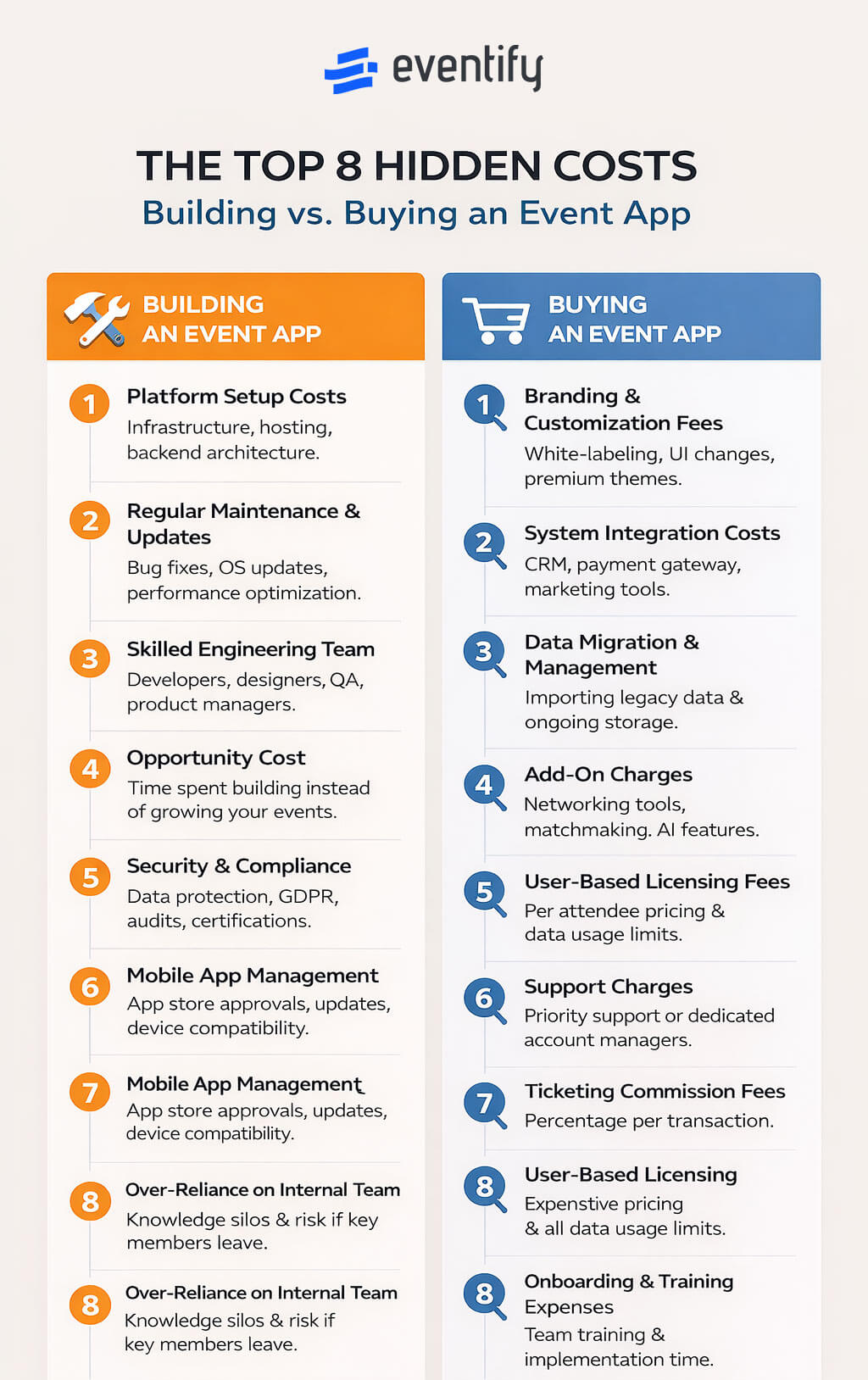
Building an Event App
1. Setting up the platform
Developing an app requires planning, strategy and effort, along with time and money. You will need to ensure that you are adding all the required features such as ticketing, registration, management and documentation along with other tools.
2. Regular maintenance & updates
When an app is made that is just the start, you will need to ensure that the app is regularly maintained, have new features and OS updates, and regular bug fixes. All this will consume approximately 15 - 20% of the cost every year initially. This cost will continue to increase in the future.
3. Skilled Team of engineers
As a company who is building an event app, it is important to ensure that it is working smoothly and for this you will need to have highly skilled engineers who are specialized in technical skills required for real time interactivity, familiar with AV, IoT integration, have high concurrency that is required for live events. An ideal team should have backend engineers, mobile developers (iOS/Android) and UI/UX designers. Hence the cost will increase while hiring the right team or outsourcing the app to an app development company.
4. Costing Opportunity
While you and your team are focusing on building an app and ensuring that it has all the features and its running efficiently, your main event business is losing focus from your team. Your attention has now been divided and this means lesser business.
5. Security and Compliance
Like discussed earlier about updates and new features, you will need to be consciously aware of security, such as data protection, GDPR, SOC 2, audits and legal reviews. Every event app has been designed for a secure, event platform that provides end to end data encryption, along with robust access control.
6. Addition of new Features
The roadmap to your event app should be designed keeping in mind the new updates and features, such as QR check-in, live polling, gamification, live polling and also AI integration. You also need to work on the requirement and expectation of the attendees, with features such as payment gateways, registration and marketing tools that are needed for connection.
7. Management of Mobile App
The mobile app should be available on both app store and google store. The mobile app developers need to ensure that the mobile version is running smoothly, with regular updates.
8. Over- reliance
When your app is completely dependent on a set of developers or a particular app developing vendor, one of the risks that you face is the failure of the app when one member of the team leaves. Hiring someone new is yet again time consuming, and this way its your business that will suffer.
Buying an Event App
1. Branding and Customising fees
There are two versions available; one the basic off the shelf event apps that is more affordable and the second is a fully customised white labeled app featuring your own branding, and they often have higher fees.
2. System Integration
When you are buying or switching for one app to another, you will need to connect the new event app with your existing CRM, registration and also to your QR and badge printing systems. These features always require additional developments or specialisation in the app and hence a higher fee is charged for API access.
3. Data Management and Migration Expense
There are platforms that will lock the attendee data charging them extra for data integration, hence making the event app more expensive.
4. Add-Ons
Most basic event app features do not have add-ons such as live polls, networking and gamification. However, these features are mostly available in white labeled app, which is curated according to the requirements of your business and your event.
5. User-based Licensing and Data Usage
Every event app available out there has their own features. Some event apps charge according to per users, some charge according to per-device, some on data usage. This will once again increase your expenses.
6. Support Charges
Most event apps that you buy will offer real-time support for troubleshooting during the main event, however they might charge you a bit more for this support and hence it is best to ask and be aware from the beginning.
7. Commission Fees on Ticketing
Selling tickets via your app always comes with a commission and it is often up to 30%. This fee is either for app store and google app, or the platform provider.
8. Onboarding and Training Expenses
When you buy a new app, whether is a basic version or a while labeled one, you and your team will need to be trained on the app and know how it works.Hence, it costs time, money and reduces productivity.
Conlcusion
Every event organiser is different and you should consider what works for you the best, however while you are debating buying vs building an event app, take a few demos of the available event app. You never know, you might just find “The One” event app that works best for you.
Ready to connect with Team Eventify, and see what features we have available to make your event smooth and stress free. Connect with us today.


.png)


.jpg)