

Introduction
Most corporate events often leave attendees disengaged with their long presentations and forced networking. However, this doesn't have to be the case. You can organise corporate events that energise attendees instead of draining them. This is where games for corporate events become necessary; they spark interaction, boost morale and create memorable experiences for attendees.
That said, we have put together 20 interactive and easy-to-organise games for your corporate events, whether conferences, strategy meetings, retreats, etc. Whether your goal is to get people out of their shells, encourage authentic networking or create collaboration opportunities, you’ll find games that align with your goals. You’ll also learn how to organise the games and how to keep participants engaged from start to finish.
Why are interactive games important for Corporate events?
.jpg)
Interactive games help transform otherwise boring, routine corporate events into dynamic and memorable experiences for both the organisers and attendees. They are structured tools that break the otherwise icy atmosphere in corporate events and help participants connect more naturally. They also enhance attentiveness and retention, ensuring the value of the corporate event isn't lost.
Additionally, interactive games foster teamwork by encouraging problem-solving and strategic thinking. It forces participants to work together, which is the foundation for collaboration and communication in the workplace. Research shows that employees are 80% more likely to network organically with one another if their interactive games are introduced in corporate events. At the end of the event, participants walk away feeling energised and more emotionally invested in the organisation.
Benefits Of Games For Corporate Events
.jpg)
Interactive games not only energise a room; they create measurable improvements in employee morale and organisational alignment. Research shows that games reduce stress and create a more conducive atmosphere for high productivity in corporate environments. Below are five benefits of introducing games in corporate events;
1. Stronger Team Spirit
Games require participants to rub minds together and rely on one another, which are essential skills for high performance in the workplace. Games such as find the missing piece or put the puzzle together help employees practice active listening and trust among themselves, which continue long after the event ends.
2. Boosts Creativity and Innovation
Interactive games at corporate events encourage imagination; participants have to think about how best to solve the problem or introduce a new perspective that could help them win. For instance, storytelling or brainstorming activities help employees break routine and improve divergent thinking, thereby generating new ideas and perspectives that can enhance performance.
3. Reduces Stress
Stress is an all-time killer of peak performance in the workplace; no employee can perform at their best when they are constantly stressed. Interactive games activate the brain's reward system, which produces dopamine that makes people feel relaxed and happier. Games that involve laughter or fun are surefire ways to achieve this effect, which improves employee satisfaction and retention over time.
4. Enhances Meaningful Networking
Interactive games remove the awkwardness and iciness from corporate events. Instead of employees forcing themselves to meet other people, games naturally create an environment where people let down their defences and connect with their fellow players. For example, a team-based puzzle can foster conversation among employees who have never interacted before.
5. Assesses Strengths
Games reveal hidden qualities that would otherwise never be known in a work environment. While the games are being played, workplace leaders can assess who leads, who takes the initiative, who provides unconventional approaches to solve the challenge, and who shines under pressure. These insights can be useful for employee promotion and workplace restructuring.
20 Interactive Games Ideas for your next Corporate Event
The right corporate events can unlock your team's creativity and strengthen workplace culture. From funny icebreakers to tasking challenges, each game must align with the event's objective and have measurable outcomes. Below are 20 interactive game ideas for your next corporate event;
1. Human Bingo
.jpg)
Human bingo is an icebreaker that encourages networking and communication among attendees through the use of prompts that help participants discover unique information about one another. It is ideal for mixers, onboarding and conferences.
How to play and organise it?
- Time required is 15 - 25 minutes
- Materials needed are pens and custom bingo sheets. Create custom bingo cards with unique/interesting prompts like “ran a marathon”, “worked in multiple countries”, etc.
- The ideal group size should be between 20 - 300
- Distribute cards and ask participants to find colleagues who match each prompt
- The first person to complete the full card gets a prize.
Participant engagement tips
- Include company-specific prompts to spark conversations about the workplace
- Encourage participants to share the stories behind some unique prompts
- Play some light music to keep the atmosphere cool.
2. Scavenger Hunt
.jpg)
A scavenger hunt gets participants to work together to find where the treasure is hidden. It makes teams work together by finding clues, assigning tasks and trusting one another, mirroring workplace collaboration. Ideal for corporate retreats, multi-day conferences and annual meetings, whether hybrid or in-person.
How to play and organise it?
- Time required: 30 - 60 minutes
- Materials needed: Unique items, score sheets, timers, and an event app such as Eventify to upload missions
- Select an outdoor venue such as a conference centre or office building.
- Create clues tied to company values or product knowledge
- Prepare bonus missions to keep teams engaged
Participant engagement tips
- Mix employees from different departments to encourage cross-functional networking
- For those online, add photo and video challenges to foster creativity
- Display a real-time leaderboard to boost engagement
3. Trivia Shutdown
.jpg)
Organise a fast-paced trivia competition tailored to the company’s history or culture. This encourages learning more about the company while building a sense of shared identity and belonging among employees. It is ideal for anniversaries and company-wide meetings, whether hybrid or virtual.
How to play and organise it?
- Time required: 20 - 40 minutes
- Materials: Trivia questions, buzzers or virtual quiz tools (for virtual events)
- Group size: Any
- Divide participants into teams and prepare different trivia categories
- Run the game in rounds. The team with the highest score wins.
- If virtual, use an event app that has a polling feature such as Eventify
Participant engagement tips
- Personal questions to make participants emotionally invested
- Add bonus rounds
- Feature humorous facts about the company to lighten the atmosphere
4. Silent Line-Up Challenge
This is an effective but silent game that strengthens team coordination and collaboration. Participants are required to do all activities without uttering a word. It is ideal for leadership retreats and team-building workshops. It works best in in-person events too.
How to play and organise it?
- Time required: 20 minutes
- Materials: None
- Group size: 8 - 20 participants
- Participants line up according to prompts such as birthday, gender, height, department, etc. without speaking.
- Faster teams move on to harder categories
Participant engagement tips
- Start from simple categories and move to increasingly complex ones
- Mix employees from different departments to encourage cross-bonding
- Debrief to share and learn teamwork patterns you observed during the game
5. The Puzzle Challenge
.jpg)
Employees are encouraged to work with one another to put together pieces of a giant puzzle within a limited amount of time. This strengthens shared problem-solving and cross-functional communication under time pressure. It is ideal for both hybrid and in-person corporate retreats, leadership development programs and team-building events.
How to play and organise it?
- Time required: 25 - 30 minutes
- Materials: Puzzle sets, timers
- Group size: 4 - 7 people per team
- Give each team a puzzle. Ensure you swap the puzzle pieces between teams
- Teams will be encouraged to communicate and work together to trade missing pieces of their puzzles
- The first team to put their entire puzzle together wins
Participant engagement tips
- Encourage participants to engage in both verbal and non-verbal communication
- Offer small rewards to boost participation
- Monitor collaboration and decision-making styles and share with participants later
6. Innovation Challenge
.jpg)
This game encourages participants to pitch innovative ideas that serve clients better or optimise internal processes. Employees develop creative confidence and strategic thinking, while
fostering a culture of idea-sharing. Ideal for R&D events, leadership summits and innovation conferences, whether in-person or hybrid.
How to play and organise it?
- Time required: 30 - 45 minutes
- Materials needed: Flip charts, sticky notes, markers
- Groups : 3 - 5 participants per team
- Each team delivers a 3-minute pitch to a panel of judges
- Judges score based on credibility, clarity and feasibility
Participant engagement tips
- Encourage employees to include humour and storytelling in their pitch
- Encourage judges to provide mentorship moments
- Play some cool music to lighten the atmosphere
- Set up live audience voting to allow the digital audience to participate
7. Debate Battles
.jpg)
Divide employees into teams to engage in debate battles about industry-focused or lighthearted topics. This develops critical thinking and public speaking in employees, enabling them to defend their ideas in a civil manner, which is a key leadership skill in professional environments. Ideal for conferences with breakout rooms, communication workshops and leadership training.
How to play and organise it?
- Time required: 5 minutes prep time per topic and 3 minutes for presentation
- Materials needed: Score cards, digital leaderboards
- Group size : 3 - 5 individuals per team
- Encourage a rapid-fire format to maintain excitement
- Judges score based on clarity, logic and humour
Participant engagement tips
- Encourage and reward diverse debate styles - comedic, bold, emotional, logical, etc.
- Add lighthearted prompts to diffuse tension and entertain participants
- Let the audience vote for the winning argument
8. Speed Networking Bingo
This game blends games with networking, allowing employees to meet people they would rather not speak with. It helps to break icy atmospheres and encourage cross-departmental communication. Ideal for large corporate conferences, anniversaries and DEI events.
How to play and organise it?
- Time required: 10 minutes per round
- Materials needed: Bingo cards, markers/pens
- Prepare custom bingo cards with fun prompts such as “Find someone who manages a department”, “Find someone who has the longest name”, etc
- Participants have to mingle to fill their bingo cards
- Give the first three a prize
Participant engagement tips
- Add icebreaker questions on each bingo card
- Use coloured cards to segment question categories for quicker answers
- Include bonus rounds and questions for deeper conversations
9. Story Cards
.jpg)
Story cards help employees connect company values with real stories. It makes company values tangible and creates an emotional connection to the company. Ideal for team-building, onboarding events, cultural events and retreats
How to play and organise it?
- Time required: 20 - 30 minutes
- Materials Required: Story prompt cards,
- Group size: 5 - 7
- Each participant gets a card that prompts them to tell a story that reflects a company's value.
- Participants share their stories in the group and the group votes on the most emotional/inspiring and the winner shares the story with the larger audience
Participant engagement tips
- Encourage participants to share authentic work-related stories
- Be gentle with participants who get emotional in the course of sharing their stories
- Use the stories to create a digital story walk for the company for reference
10. Two Truths and a Lie
This is a classic but exciting game where participants reveal fun facts about themselves, and others are meant to guess which is true and not. It helps foster curiosity and connection among employees. Ideal for small in-person events such as team-building retreats, training workshops, company meetings, etc.
How to play and organise it?
- Time required: 15 - 20 minutes
- Materials required: Small prompt cards, an event networking app to act as a timer
- Group size: 7 - 10 people
- Each person shares three facts - two true and one false - about their life, career, interests, etc.
- Group members are required to identify the lie. Usually, the reveal leads to follow-up questions which foster connection.
Participant engagement tips
- Encourage participants to share non-related work facts to deepen employee connection. However, advise that they should be careful with sensitive information which may affect other people's perceptions of them.
- Encourage follow-up questions but control the time
- Use an event networking app to keep the scores of each group.
- Appreciate the winning group at the end of the game
11. The Photo Story
This game requires participants to share a 60-second story from one of their recent photos on their phones. It is a low-pressure game that inspires work-life integration and builds trust among employees. Ideal for in-person and virtual event formats, and team meet-and-greet, small meetings and employee bonding hangouts.
How to play and organise it?
- Time required: 2 minutes per participant
- Group size: Divide participants into small groups of five
- Instruct participants to create a 60-second story about the fifth photo on their phone when they open their camera roll
- If inappropriate, they should select the next one
Participant engagement tips
- Play soft music to create a relaxed atmosphere for sharing the stories
- Encourage participants to be authentic with their stories. The goal is not perfection but connection.
12. The Broken Square
.jpg)
This game entails participants divided into teams and given a complex geometric puzzle to solve. They must fit the broken pieces perfectly into the puzzle, but they cannot speak to one another. This game fosters listening and observation skills through non-verbal communication. Ideal for in-person focused workshops.
How to play and organise it?
- Time required: 15 - 20 minutes
- Materials required: Cutout cardstock pieces that form a perfect square when correctly assembled
- Group size: 5 participants per group
- Participants must stick to the rule of no talking. Any group that talks is disqualified.
Participant engagement tips
- Encourage participants to work together to assemble the perfect square
- Gently remind the group not to talk if talking occurs
- Observe how participants use non-verbal communication cues to relate with one another.
13. Desert Island Survival
Participants are grouped into teams and are required to decide which 10 items (from a long list of 20) a survivor on a desert island needs. Though a fictional scenario, this exercise promotes critical thinking, consensus-building and risk assessment. Ideal for training workshops, annual meetings, and decision-making events, whether in-person or virtual.
How to play and organise it?
- Time required: 15 minutes for discussion, 5 minutes for debriefing
- Materials required: A long list of 20 items required for survival on a desert island, an expert’s ranking sheets to verify choices
- Group size if any: 5 persons per group
- Each group ranks the items and prepares its list
- Each group list is judged against the expert’s ranking sheet
Participant engagement tips
- Encourage participants to discuss extensively among themselves before settling on an item
- Encourage teams to include everyone's opinion in the list
- Reward any group that reaches a consensus in under 15 minutes
14. The Six Thinking Hats Problem-Solve
This structured ideation method, developed by Edward de Bono, uses six thinking hats to analyse a corporate problem. Teams adopt all six approaches to solve the problem. Ideal for strategic planning meetings and complex project meetings whether virtual or in-person.
How to play and organise it?
- Time required: 30 minutes
- Materials required: Problem prompts for each team to deliberate on
- Group size if any: 5 participants per team
- Teams discuss the problem based on the approach they adopt
- After the discussion, each team shares the result of their approach with the others
- Ensure every approach in the six thinking hats is covered. This means you must have at least six teams
Participant engagement tips
- Encourage team members to share their opinions and actively participate
- Reward the teams that provide a unique perspective
- Play soft background music to create a relaxed atmosphere
15. Team Mural
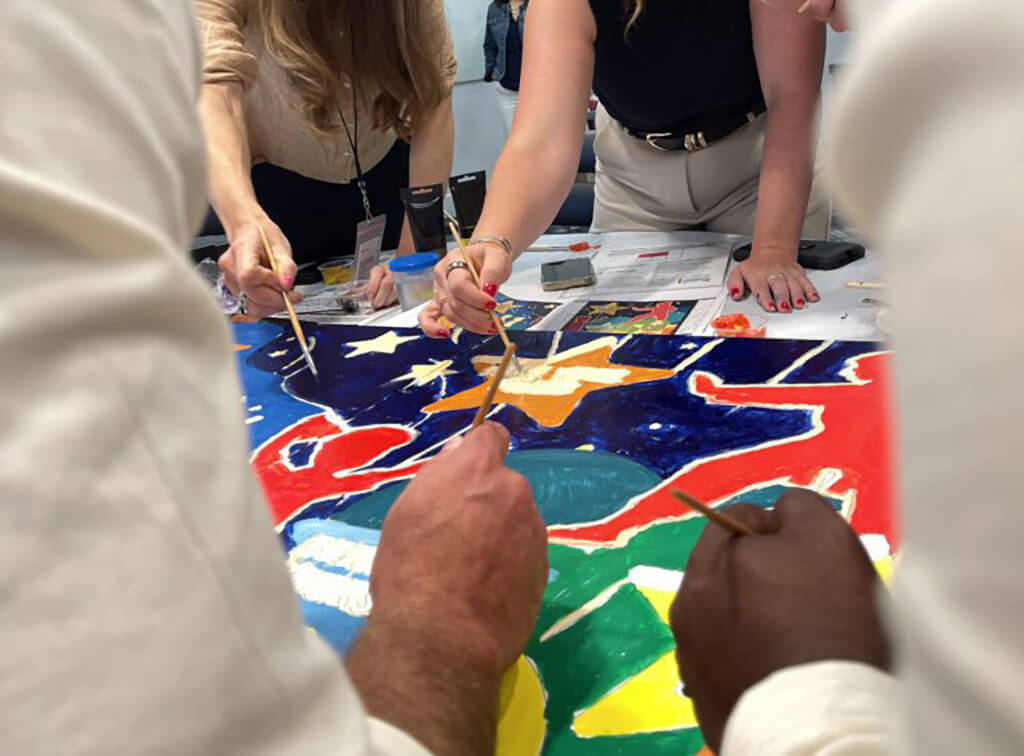
Participants are divided into teams and given a large canvas to collaboratively create a piece of art that represents a specific corporate value. This fosters shared vision-building and value creation among employees. Ideal for in-person events such as vision-planning, team-bonding and company anniversaries.
How to play and organise it?
- Time required: 40 minutes
- Materials required: A large blank canvas, markers, tape, glitter, supply paint, etc
- Group size: 5 - 7 people per group
- Groups must agree on a concept before they start painting, so they can flow together and manage resources
- Encourage groups to spend less time deliberating and more time creating
Participant engagement tips
- Encourage members to show their artistic skills based on the concept their group chooses
- Play soft background music to encourage little talks among members while painting. This can be a means of meeting new people
- Gently remind members of how much time they have left when you observe they are slacking
16. Caption This!
.jpg)
This is a photo contest that requires attendees to write the most creative or funny caption for some pre-selected photos of funny company moments. It helps to create humour and foster creativity among employees. Ideal for both in-person and virtual events such as breakout session openers, happy hour, team retreats, strategy meetings, etc.
How to play and organise it?
- Time required: 15 minutes
- Materials required: 8 - 10 photos capturing unique or funny company moments, an event app such as Eventify for attendees to submit their captions
- Project the photo and ask attendees to submit their captions within a given timeframe. After, move to the next photo and repeat the process
- Reward the person who gave the most witty or funny caption
Participant engagement tips
- Encourage participants to share their thoughts freely. You can decide to set up an anonymous voting option on the app for participants who prefer this option.
- Project each photo for at least 2 minutes each to allow participants to think about suitable captions
17. The Collaboration Maze
.jpg)
Participants are divided into teams to navigate a virtual or physical maze where success depends on communication and collaboration. This game reinforces a knowledge-sharing culture among employees. Ideal for cross-department retreats and strategy alignment meetings whether in-person or virtual.
How to play and organise it?
- Time required: 20 minutes
- Materials required: Maze grids (if in-person); if virtual, use an event app
- Group size : 3 - 5 persons per group
- Team members must work together to choose the correct path
Participant engagement tips
- Encourage participants to collaborate and reflect on every member's opinion
- For virtual events, divide participants into breakout rooms and check in on them occasionally
- Reward the team that gets the correct path first
18. Shark Tanks
Similar to the real-life Shark Tank, this classic pitch game sharpens critical thinking and product development. Participants pitch deliberately flawed product ideas while others critique them and decide whether to “invest” or not. Ideal for sales workshops, innovation summits and leadership retreats. This game works for all event formats, whether in-person, virtual or hybrid.
Find the Best Corporate Event Management Software that can help execute the games easily.
How to play and organise it?
- Time required: 30 - 45 minutes
- Materials required: “investment tokens” for employees
- Group size : 3 - 5 people per group
- Each team deliberates before pitching its ideas to the audience
- Attendees critique the ideas and decide whether to invest by giving the team “investment tokens”
- The team with the most investment tokens win
Participant engagement tips
- Encourage participants to question the teams
- Play soft background music to diffuse tension
- Offer small rewards for the winning teams
19. Talent Match
.jpg)
This game entails employees listing three skills each that have nothing to do with their job titles and others have to guess who possesses the skills. This game reveals hidden strengths and humanises employees beyond their jobs. Ideal for culture-building and team-building events, cross-functional summits and onboarding, whether virtual or physical.
How to play and organise it?
- Time required: 30 minutes
- Materials required: Talent cards where employees list their three skills anonymously
- The facilitator reads out each card and asks participants to guess the owner of the skills
- You can use scenarios to explain each skill to give a storytelling effect
Participant engagement tips
- Allow participants to guess the owner of the skills without prompting
- Reward the person with the most talent-owner match
- Encourage follow-up questions on each talent-owner match reveal
20. Negotiation Challenge
.jpg)
Participants negotiate fictional and realistic business scenarios such as client deals and new market penetrations. This game enhances conflict resolution skills and builds organisational competence of team members. Ideal for leadership programs, sales training and management meetings, both in-person and virtual.
How to play and organise it?
- Time required: 15 minutes per negotiation round
- Materials required: Negotiation card prompts
- Group size : 3 - 5 people per team
- Each team presents their deliberations to the judges
- Judges must score each team based on the quality of the outcomes of their decisions
- If virtual, use breakout rooms to mimic a real-life negotiation setting
Participant engagement tips
- Encourage participants to come up with tangible outcomes from their deliberations
- Encourage the judges to be fair in their critique. They can come up with a set of metrics to standardise the process.
- Debrief on insights and dynamics to ensure everyone learns from the process.
Find out more ideas like these in our 30 Corporate Event Entertainment Ideas.
Organise Your Corporate Events Effortlessly Using Eventify
Organising memorable corporate events becomes easier when you introduce interactive games and make use of tools that reduce your workload. Eventify is an all-in-one event management platform that streamlines the entire event experience from handling registrations to live engagement to providing in-depth analytics. As such, you can focus on introducing games that will transform the event into a dynamic experience. Eventify also allows you to monitor participation and measure engagement among employees during the games.
Whether you are hosting a small event such as a department strategy meeting or a large event such as an annual conference, Eventify ensures everything goes according to your plan. If you are ready to create memorable experiences out of your corporate events, explore Eventify by booking a free demo here.
.png)